Monday, February 10, 2014

ramblings from an email (I think I am getting the flu....)

Man, everyone is all 'MANSFIELD PARK IS SOOO HORRIBLE OOOOOMG' and....it's not that bad! It's not P&P, no, but it's a helluva lot better than, say, trying to read Shirley after Jane Eyre, and MP's psychology and characterization is really interesting. There's some fascinating parallels to JE for one thing -- poor girl brought up in rich house, secretly in love above her caste, trying to negotiate high society.....but very realistic, not Romantic. This is the reality principle full bore, which is why people don't like it, I think. Yeah, it's hard to bear sometimes, but it's not awful.

I seem to be having the opposite reactions from everyone else (typical!): Fanny is kind of sweet (yeah she's passive and a bit wet, but God, look at how she was brought up), Mary and Henry are horrifying (she's rude in the guise of being witty, he's like some awful version of Valmont (("I just want to make the....very....tiniest hole....in her heart!" YOU CREEP)), I don't think Austen is actually 'defending the values' of patriarchal estate society or whatever (Jane Austen? Satire is conservative by nature, but....yeah no), and I don't think it's even really that religious a novel.

In Austen there's a lot of conversation about religion in society, particularly what livings are worth &c., but it's not like Victorian novels, even Bronte's, where people are appealing to God every other paragraph and talking about their Christian duties &c &c. Hell, even in the Gothics Catherine is so fond of, there's paens to how God created all of this for us nearly every fifteen minutes. Austen is very worldly. It's like reading Chaucer about, who's the really awful one, the Summoner?

In fine: reading Victorian novels has clearly made me a hardened character.

Sunday, February 9, 2014

there but for the

“I’ve been to three meetings since it happened,” said Rita, who was sitting in a restaurant on West 10th Street on Monday following a recovery meeting, and who, like others interviewed for this article, requested that her last name be left out in accordance with A.A.’s tradition of anonymity. “There hasn’t been one meeting where I haven’t heard about it. People in the public eye see it as ‘We lost a great talent.’ People in recovery see it as ‘We lost a brother in arms.’ ”

- For Some in A.A. and Other Addiction Recovery Groups, the Death of Philip Seymour Hoffman Hits Home

'How is the consternation of the party to be described?'

I have one word to describe my consternation and it is DREAD. With this book we leave the sparkling early work -- "the first of the three novels of Jane Austen's maturity," Drabble somberly says. Martin Amis is not helping:

No reader can resist the brazen wishfulness of “Pride and Prejudice,” but it is clear from internal evidence alone that Austen never fully forgave herself for it. “Mansfield Park” was her—and our—penance.

I think I've read the first fifty pages of this. Long, long ago. Oh God.


Early opinions of MP My Mother -- not liked it so well as P. & P. -- Thought Fanny insipid. Man, when your mama doesn't like your book, that's bad.

The 'Fanny wars' (gotta adore that 1996-era DANGER! graphic at the top)

Number of times Fanny actually cries in the novel (fourteen total apparently)

'To Pemberley, therefore, they were to go.'

And BOOM goes the dynamite as Jane sets off the careful intricate fireworks display of plot she's been building up for over two hundred and fifty pages now.

This time around I really noticed how much the novel continues to be about Elizabeth's emotional education: Darcy goes through the same process offstage, but the focus is still all on her, as she hears the testimony of the housekeeper, observes the portrait, reads the letter from her aunt, and so on. Part of what gets me down about this actual conclusion to the story is Darcy is the one getting all the action (that's what she said): finding Lydia and Wickham, bribing and bullying them into being married, confessing to Bingley -- in short acting like a knight performing brave deeds to win the love of his lady, who just gets to watch him do it. (Although, characteristically, Elizabeth is the one who slays the dragon Lady Catherine, right in front of us.)

But more distressingly, for so much of Vol III, Elizabeth is stunned, suspended in horror; I don't think she even makes any jokes, except bitter ones ("I do not particularly like your way of getting husbands") until she gets to tease Jane about Bingley in chapter twelve. The teasing goes on, but we don't see "her spirits rising to full playfulness again" until after she has told her father "I do, I do like him....I love him" -- her sparkle, if not quenched, has been terribly dimmed for about a hundred pages.

....But such high-minded objections aside, the real reason I can't really love Vol III is because it's fucking nervewracking. When my husband and I were watching the 1995 adaptation (as it was airing -- God, I'm so damn old) he was going quietly frantic trying to pry out of me whether or not Darcy and Elizabeth got married, and in exasperation I finally said "Well, what do you think, would it be this popular if they didn't?" He said, "OK, OK, I know they must get married, but I can't see how right now." As Martin Amis, of all people, wrote when that adaptation was released:

This autumn, as the new serial got into its stride, distressed viewers rang up the BBC in tears, pleading for the assurance that fate would smile on the star-crossed pair and all would yet be well. I was not among these callers, but I sympathized. And I quite understood why the “Pride and Prejudice” video, released midway through the run, sold out in two hours. When I was introduced to the novel, at the age of fourteen, I read twenty pages and then besieged my stepmother’s study until she told me what I needed to know. I needed to know that Darcy married Elizabeth. (I needed to know that Bingley married Jane.) I needed this information as badly as I had ever needed anything. “Pride and Prejudice” suckers you. Amazingly—and, I believe, uniquely—it goes on suckering you. Even now, as I open the book, I feel the same panic of unsatisfied expectation, despite five or six rereadings. How can this be, when the genre itself guarantees consummation?

Which is exactly my experience with it. EVERY TIME. There I was, panicking away as Jane played me rather more deftly than Mary played her piano. When you read, say, Oedipus Rex, the dreadful suspense depends on your not wanting to know what you know is happening right in front of you: it is driven by denial. But when you read -- and reread -- P&P the dreadful suspense goes on happening even when you know beyond a doubt that what is going to happen is what you need to have happen. Jane is Sherlock and Watson at once: performing the impossible mental brilliance, and telling us as she does it. No wonder it redefines the word "popular." Five thousand years from now there will probably be cockroaches artfully lit in miniature Regency gowns made out of scavenged carpet fibers, suckering each other with the story.

If P&P were indeed "only" a romance -- and I have here spared you a thousand-word-long rant on what Romance means, including the inevitable Hawthorne reference, be grateful -- it would end at about the point where Elizabeth has begun to triumph ("Bingley was ready, Georgiana was eager, and Darcy determined to be pleased"). Instead we read with her Jane's dreadful news of Lydia's elopment with Wickham, and Darcy is of course right there, and Jane gets to work tightening the mental thumbscrews: "and never had she so honestly felt that she could have loved him as now, when all love must be in vain." In my horribly acid-green-covered paperback of the moment, last night I scrawled the brief but eloquent annotation "AUGH." I have probably thought something like "AUGH" every single time I have ever read that sentence.

If the genres of romance and suspense depend on the artful putting-off of what we know is going to happen (for instance, Hitchcock putting off the opening of a trunk for an hour and a half), the much-derided phenomenon of wish-fulfillment, P&P depends on something completely different: the dread that what we need to most have happen inevitably never will. Austen has created a perpetual motion machine of a story driven by the reality principle. That she finishes it off convincingly with a melding of fantasy and reality (Elizabeth's inferior connections pester her until the very last page) is final proof of her genius.

Saturday, February 8, 2014

"Till this moment I never knew myself"

Vol I is world-class, and Vol II is better. Austen does not go so much from scene to scene as from strength to strength -- Charlotte's married fate, Lady Catherine's not-so-petty tyranny, the Worst Proposal Ever, the letter -- can we pause to note that the moral turning point for our heroine occurs when she is by herself, reading and rereading, and carefully thinking over her own observations and judgments? The Letter Scene is an aria of psychological acuteness, right up there with Dorothea's similar realization about her own life over half a century later: an amazing moment where the heroine's awareness of herself, her entire world, is transformed completely by her own insight.

Minor points:

- Jane's quiet yet deepening depression is like a sad minor return of Marianne's hysteria and near-fatal illness. Poor Jane! fading away....

- I completely forgot about Col Fitzwhatshisname, who is sort of like Darcy Lite. Elizabeth isn't that insulted that he apparently likes her, but not enough to be poor with her (these guys complaining about poor women remind me of Marilyn Monroe's gold-digger: "I don't want to marry him for his money, I want to marry him for your money!"). He and Charlotte both allow mercenary concerns to dictate their love lives, but the author doesn't condemn either one of them. What else are they supposed to do? seems to be the conclusion. It's like Ellen Olenska gently reproving Newton Archer: "Oh, my dear—where is that country? Have you ever been there?"

- Trying to draw biographical conclusions from literary works is especially pointless when it comes to Austen, but there are so many repetitions in the novels of a kind of primal scene where a heroine offends propriety and suffers for it (Marianne confronting Willoughby, Catherine suspecting the general, Lydia and Kitty chasing after soldiers) you have to wonder if something like that happened to "the prettiest, silliest, most affected, husband-hunting butterfly" who grew up into our author. I have to, anyway. (Ditto the echoes of "Willoughby," "Wickham"....)


....damn, I might just reread Vol II again before going on. It's not as sparkling and delightful as Vol I, but I just want to love it and squeeze it and call it Georgiana.

fifth (or is it sixth?) impressions of Vol I

- I am ashamed to say I did not click with this book until WELL into my thirties. //hangs head

- Vol I really just flies by -- glides, sails, leaps, swoops, whatever. I don't so much read it as just consent to be carried along on waves of delight, which sounds, Jesus, so soppy -- but life has been in the shitter lately and yet I stayed up until about three AM rereading this story I've reread half-a-dozen times, utterly absorbed, because it is just that good. 

- How does she do Jane and Bingley so well? In anyone else's hands they'd be soppy and unconvincing. Austen just makes you want to snuggle them, they are so adorable. Susannah Harker and Crispin Bonham-Carter were perfect (I need to rewatch that!).

- Everyone goes on about bright light witty sparkling &c. (including the author herself), and that is certainly spotlit, but there's also a nearly grim quality at times -- the shadows are much darker. It's somewhere between the pastoral of S&S and the mind-numbing sociability of Bath in NA -- all those sisters are stuck in the country, but there's no real place to retreat to (altho Elizabeth reminded me of Catherine and Marianne on her epic walk, and when she runs off from Darcy and the Bingley sisters to explore on her own). Mrs Dashwood and Mrs Bennet are perhaps not completely dissimilar characters, but their treatment makes you like one and, at best, pity the other. Catherine, Marianne and Elinor are all secure in their homes, in love and affection; without Jane, Elizabeth has nothing in common with the other half-dozen women of the house, and she can't shut herself up in her father's library snarking forever. Home is a place of discomfort, even emotional danger. Elizabeth is closer to Jane than Marianne and Elinor ever were, but she can't really count on anyone else.

- I had forgotten how totally besotted Darcy is with her. He's like a puppy dog. "I would be in danger were it not for her inferior connections!" -- yeah, right, pal. Is he so anxious to quash Jane and Bingley's romance because he's projecting his own bewilderment about being so attracted to a woman he considers so unsuitable? Jackass.

- Boy, I like Mr Bennet less and less with every single rereading. Drabble is rather wry in her preface about young bookish girls who defend him as a father figure and dislike Mrs Bennet (she is equally wry a few paragraphs later about modern feminists who want to rescue Mrs Bennet, possibly out of the protective urge to make Elizabeth have one parent that isn't worthless).

- Auntie Jane is calmly up-front that Elizabeth's best friend has just prostituted herself in marrying a repellent man who can provide financial security and moreover that this is what society expects her to do and Elizabeth is going against the grain by objecting to it. Mr Collins is a figure of high comedy, but he's also the "best" these young women can probably do, and he knows it and they know it and it just exponentially increases his comic awfulness. "Amorous effects of brass" indeed.

- Mr Collins: never never anything but hilarious. Oh God -- the toadying! the emphasis on sucking up to Lady Catherine! the endless speechifying! SO TERRIBLE. And yet so funny I actually woke my partner up at 2:30 in the morning (he was quite sweet about it) helplessly laughing over the Second Worst Proposal Scene Ever (second only because Darcy's Worst Proposal Scene Ever is in the same book, which alone ought to qualify it for immortality).

- The end of Vol I isn't as bad as the end of S&S's Vol II but it's still pretty grim. Bingley has dumped Jane, Elizabeth has lost Charlotte to Mr Collins, and with Bingley gone the girls are stuck walking to Meryton for entertainment. Yikes. Vol II continues very smoothly on from there: Bingley has decamped for good, Caroline is really snotty to Jane by mail, Wickham dumps Lizzy for Miss King's ten thousand pounds and there is the awful, wonderful, horrible set piece where we see Mr and Mrs Collins, At Home. We get the fabulous aunt Mrs Gardiner (with her foreshadowing a visit to the lakes!), but we also get first sight of the awful, non-comic Lady Catherine, that formidable enemy. And with the idea of her being "a most active magistrate in her own parish" I suddenly was not laughing anymore, and found I was tired, and went to bed.

Friday, February 7, 2014

God help me I have just got to quit Tumblr again (xpost)

 "Nothing further to alarm perhaps may occur the first night. After surmounting your unconquerable horror of the bed, you will retire to rest, and get a few hours' unquiet slumber. But on the second, or at farthest the third night after your arrival, you will probably have a violent storm. Peals of thunder so loud as to seem to shake the edifice to its foundation will roll round the neighbouring mountains—and during the frightful gusts of wind which accompany it, you will probably think you discern (for your lamp is not extinguished) one part of the hanging more violently agitated than the rest. Unable of course to repress your curiosity in so favourable a moment for indulging it, you will instantly arise, and throwing your dressing-gown around you, proceed to examine this mystery. After a very short search, you will discover a division in the tapestry so artfully constructed as to defy the minutest inspection, and on opening it, a door will immediately appear—which door, being only secured by massy bars and a padlock, you will, after a few efforts, succeed in opening—and, with your lamp in your hand, will pass through it into a small vaulted room."

"No, indeed; I should be too much frightened to do any such thing." 

Finally realized why I don't like Henry and Catherine as a couple -- they remind me too much of Willoughby and Marianne, except Catherine is even more naive and sheltered, and much less intellectually independent. I have been telling people for a while that Margaret Drabble is the one who argues in her introduction that they turn into Mr and Mrs Bennet, which seemed so dreadfully accurate it RUINED the book for me, but I've been through the introduction again now and Drabble says no such thing. MARGARET FORGIVE ME. Obviously some critic says it, probably in an introduction, since other people have heard the same theory, but I have no idea who it was now. sigh. (xpost)


Thursday, February 6, 2014

Dontgonearthe Castle

I thought I would get right into Northanger Abbey and have difficulty getting through Sense & Sensibility, but NA is instead proving surprisingly hard to read (altho it did take a couple of days to begin S&S properly, too). I think part of it is what I disliked about Austen so much as a Bronte-mad teen -- she writes about the constrictions of society so well, the endless empty chatter about fashion, and the gossip, and being stuck with people you have nothing in common with inside for hours on end, that it just drove me nuts and I would escape back into Jane Eyre and Wuthering Heights.

There was some of that constriction in S&S, to be sure, but it didn't feel quite as bad -- maybe it's because Catherine doesn't have a sister with her, and she seems permanently stuck in the goddamn pump-room. (Also, I had Marianne. Marianne! how I continue to adore her, always.) I know I read this in grad school (around 1994? //cough creak tap cane) and at least once since then -- only a few years ago in fact! -- but large swathes of it have just disappeared, which again is the opposite of what I expected with S&S -- passages of that started coming back to me as I read it, or at least I recognized them -- it's an odd feeling to describe, but sort of like recognizing your way home in a city, I think. ....Not so now. sigh.

I'm on chapter 5, Henry has disappeared, Isabella has just appeared, I want to drown Mrs Allen in a bucket and I think the best thing that could happen to Bath would be a neutron bomb. //grits teeth and reads on


-- Altho WAIT then I got to the great diatribe In Defense of Novels, which cheered me up. God, Jane is an intrusive narrator here. (She finished this before S&S, I think....? but then revised it) I think I'd do better with it as an audiobook, maybe.


Further thoughts:

- I know everyone loves him but good fucking God I can't stand Henry Tilney, he keeps patronizing Catherine

- the passages about books and reading are really good

- this goes a bit better if I picture Catherine as a kind of female Candide in muslin. A bit

- every time Isabella says something I want to scream, altho that's partly because she reminds me horribly of someone I used to know

- FINALLY WE'RE OUT OF FUCKING BATH 

Tuesday, February 4, 2014

'All within Elinor's breast was satisfaction, silent and strong.'

Vol III also flew by, altho it wasn't quite up to Vol II in terms of characterization and sheer suspense. I am in the position of the immortal ass in the anecdote who finds his grandfather isn't quite as dumb as he supposed. This Jane Austen, she's a pretty good writer! Have you heard? (That said, I still think we should have read P&P at St John's, but no matter.)

The "through line," in today's awful modern slang (God, I sound old and wizened. Hang me up on the wall in a bag) is of course Marianne's terrible illness, which is brought on by her "sensibility": Mrs Jennings, in whom we are to trust as a nurse (Austen specifically says she has experience, and she is able to tell Marianne is gravely ill in spite of Elinor's denial) attributes it to her emotional agonies in London, and it is paralleled with her injury in Vol I: just as she went out in bad weather and became emotionally ill, infatuated with Willoughby, she insists on being physically vulnerable while dwelling on her lost love. Austen explicitly links her wanderings to Romantic symbols: the Grecian temple, winding shrubberies, hill vistas, twilight. (You can picture academics drawing entirely the wrong kind of lesson here: Young girls! Don't go outside when it's raining!) -- This is one of the few places where the movie fumbles: instead of Marianne fancying "that from their summits Combe Magna might be seen" (oh, Marianne), La Winslet stands in the rain, sopping, staring right at the house, and recites Shakespeare. It's very over-the-top, but very Marianne. -- When Elinor and Marianne take their first walk together after Marianne's recovery, Austen echoes Marianne's and Margaret's opening walk, which Drabble links to Dorothy Wordsworth "who, at precisely the period of composition (1798) was writing her Alfoxden Diaries". Marianne is emotionally recovered as well, for she somberly says: "'There, exactly there,'—pointing with one hand, 'on that projecting mound,—there I fell; and there I first saw Willoughby.'" It is the end of her sentimental education, and the true conclusion of the novel, rather than the hastily told-about marriages (which the movie of course dwelt lovingly on, God bless it).

But the great emotional set piece of this concluding volume -- of the whole book really -- is of course Willoughby's confession to Elinor. Apparently Austen is riffing some on the idea of the recovered rake in Clarissa, and I have never read Clarissa, and Clarissa is apparently about ninety zillion pages long, and people don't read it unless they're in grad school and I dropped out of grad school in 1996 so you can see where this is going. If it's true S&S was originally an epistolary novel, Austen probably shaped his monologue from a long letter, and it's easier to imagine Elinor reading it alone rather than sitting still listening for so long -- especially when she's expecting Brandon with her mother in what, an hour? But Willoughby's actual presence does heighten the scene's suspense, and underlines his rashness. It's an astonishing speech, and reminded me of nothing so much as Rochester's confession of his own libertine past to the virginal Jane Eyre (which is based also on Pamela).  Willoughby is not morally redeemed, as Marianne is; he doesn't die, unlike Lovelace; and as Austen takes care to tell us at the end, he isn't even that unhappy. But we and Elinor do understand his behaviour, awful though it was (and you can't doubt he will continue to cheat on his wife, and seduce young girls, or at least I can't).

(Another flourishing villain is the again-triumphant Lucy, an amazing creation; she climbs in society, but as Austen acidly remarks, she "may be held forth as a most encouraging instance of what an earnest, an unceasing attention to self-interest, however its progress may be apparently obstructed, will do in securing every advantage of fortune, with no other sacrifice than that of time and conscience." It is a mark of Austen's realism that Willoughby, and the Lucy-Robert and John-Fanny pairs which shadow our heroes and heroines, live out their days with no further punishment than the admittedly awful one of having to be their own selves.)

But the focus isn't on Willoughby -- at least not for long: he says his (extremely long) piece, gains Elinor's forgiveness and dramatically (of course) exits. Austen's emphasis is on Elinor's listening to the story, and especially on her repeating it to Marianne; not to reunite the lovers, but to reassure her sister "he was not always acting a part, not always deceiving" her: he was "only fickle, very, very fickle." It would be easier for the sisters to hate him, and for Austen to dismiss him entirely (as she does dismiss Fanny and John, and Lucy and Robert). Somewhat surprisingly, in a novel always seen as Emotions v Reason (blame the title), Austen attributes nearly all of her villains' worst behaviour to lack of education: Lucy, her sister, Willoughby, and Robert are all spoiled by their culture, especially its materialism, and even Edward is harmed by his enforced idleness (in an amusing twist, Robert attributes Edward's "faults" to his education!). It's not a coincidence that Marianne's first plan after her recovery is self-education -- Austen pokes fun at her typical zeal, but not the idea itself. The ideal is not so much reason overcoming emotion as Plato's allegory of the two horses pulling the same chariot together.

And Marianne's last moving speech, which summarizes her moral flaws in the same way Elinor meditates on Willoughby's at the end of his confession ("The world had made him extravagant and vain—Extravagance and vanity had made him cold-hearted and selfish") focuses not on Willoughby, her past love, nor Brandon, her future husband, but her sister: " Had I died,—in what peculiar misery should I have left you, my nurse, my friend, my sister!—You, who had seen all the fretful selfishness of my latter days; who had known all the murmurings of my heart!" True to form, she immediately swears to live only for her family and studying, and has hysterics when Elinor hears of Lucy's final chilling "flourish of malice," but we cannot doubt she has changed, and the relationship between the sisters has changed also. Even after the concluding marriages, Austen emphasizes how they live happily "almost within sight of each other," and we are reminded the story was first called Elinor and Marianne.


-- On to Northanger Abbey, which I think I reread a couple of years ago after reading Mysteries of Udolpho, in the hope of getting more of the in-jokes (I first read NA in grad school, in a Gothic Lit course). This was a mistake: you don't really understand the in-jokes much better, and Udolpho is full of lavishly described trees, and bad poetry. I think I enjoyed NA pretty well last time, so I'm not expecting this reread to be as surprising as the S&S experience was, but I could be mistaken again!

Monday, February 3, 2014

S&S - Vol II

Reading progress. At chapter seven -- after Willoughby has snubbed Marianne at the party, when she gets his awful letter. I don't know what Young Moi was thinking (well no, I know just what she was thinking; she was thinking of Jane Eyre) -- this is great stuff. Poor Marianne! Austen sees her so sympathetically, too -- she's not just a "silly girl," her swooning infatuation isn't even the problem, but it's more a moral and psychological one -- she's gone to such emotional extremes she has no reserves for herself, she's given herself away, and to someone who preys on just that kind of innocent excitable young girl (it always shocks me Willoughby is twenty-five, and seducing sixteen- and seventeen-year-olds). Elinor is very sympathetic too, like when she just sits down and takes Marianne's hand and cries with her after The Letter. Harrowing. Would any other author treat a sixteen-year-old girl's first romantic disappointment so seriously and thoroughly?

Mrs Jennings, so unbearable at first, becomes nearly something out of Shakespeare -- she's presented as comic but with great largeness of spirit, like Mistress Q's reporting the death of Falstaff (which always makes me laugh and then cry). Felt this particularly with her complete irrelevance about the mulberry tree, so utterly inappropriate and silly given the conversation, but really a celebration of life's triviality, and human appetites. Austen sees her terribly clearly, but all the more sympathetically for that -- no wonder Woolf was always calling her Shakespearean, it's the same kind of near-tender regard he has for almost all his characters (Shakespeare's "Olympian detachment" is almost as big a pile of bullshit as Hamlet's rep for being indecisive). Her husband Sir John isn't quite as fully drawn, but he gets some wonderful comic moments ("It was only the last time they met that he had offered him one of Folly's puppies!"). Colonel Brandon also comes fully into his own as a character, of which more below, and we get the full horrible picture of the Steeles, and even further elaboration on the selfish materialism of the dreadful John Dashwood (more below ditto).

COL BRANDON BEGINS HIS TALE. //swoon Yeah, yeah, it's the Alan Rickman effect, whatever. Pemberley has an interesting comparison between the ages of all the characters and the actors who played them -- Rickman was actually forty-nine, not thirty-five, but he seems so much more youthful to me than my first mental picture of Brandon. Who pointed out Col B is a Byronic hero, but all his action (falling in love, searching for his ward, duelling W) happens offstage? (More evidence this was an epistolary novel to begin with, if you ask me.) -- Also, you can tell Marianne will be happy with Brandon (she will!) because he's so much like Elinor, who loves her.....altho wait, his dead love's daughter whom he loves as his own is a year older than Marianne?.....Ick. And I think Mrs Dashwood is only five years older than he is? ....ick squared. I think that also means, if she has nineteen- and sixteen-year-old daughters, that she wasn't that much older than Elinor when she married.

 But along with the warm comedy, and the deep appreciation for Brandon, we get an absolutely chilling scene -- this is some of the best writing in the novel. Margaret Drabble points it up in the introduction, where she calls it "shocking," and it is: Elinor's half-brother appraises Marianne as if she were one of Willoughby's hunters, pricing her to the nearest hundred, in the horribly appropriate setting of a jeweller's: women are bought and sold, like seals and toothpick cases. He is even more insulting when he 'congratulates' Elinor for capturing Brandon for his wealth, and his awfulness is rounded out by his own false insistence on poverty and supposing that the Dashwood girls are sucking up to Mrs Jennings for money. And yet nothing is forced or drawn heavily -- it's just a buffoon rattling on to his half-sister in a smart shop about his property and her marriage prospects, but there is deep contempt for the mercenary society which produced such a specimen in every line.

This is relieved, somewhat, by the near-Shakespearean light comedy of Lucy and Edward and Elinor all being suddenly stuck in the same room together, which was done to very good effect in the movie. It's all very sparkling and witty, without much real damage being done (on the surface at least), but this leads up to the crescendo of Fanny Dashwood essentially replacing Elinor and Marianne with Lucy and her sister -- indeed this whole part, set in the corrupt town rather than the pastoral comfort of the first volume, might be called Lucy Victrix -- she's like a pocket Becky Sharp.

In fine, this part FLIES by -- it's payoff for the laborious setup of Vol I, like a really good third act in a play. I don't remember much about Vol III, except Marianne's dreadful illness, and am a little apprehensive, but much more appreciative than I was after Vol I.

-- ETA -- and on opening Vol III, Austen's fine sense for absurdity immediately has Lucy's fortunes reversed in the most hilarious and humiliating way.  VIPER IN MY BOSOM, I think Fanny Dashwood shrieks in the movie.

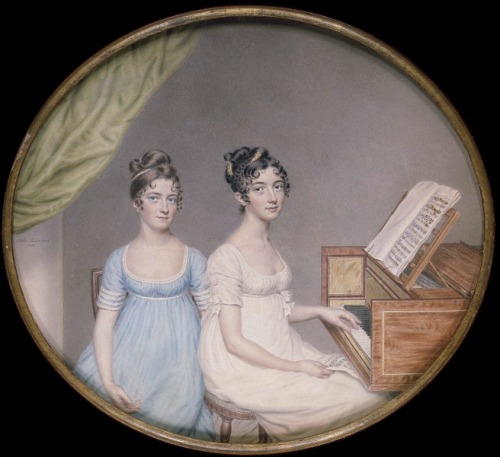
'Miss Harriet and Miss Elizabeth Binney' by John Smart (1806)


This is on the cover of the Signet Classic paperback I have, which I bought SOLELY for the Margaret Drabble introduction. The intro is dated 1989, but my paperback is from 1997 (and cost $4.95 back then — I think I got it used for about $2). It’s “clean and tight” as the booksellers say (that’s what she said) but the covers are spotted brown on the inside and I checked the back matter and the pages started to peel apart at the end. Yikes. I’ll have to be a little careful with it.

'and Elinor then was at liberty to think and be wretched'

END OF VOL I. Boy that was a bit of a slog, but it starts ramping up near the end. Willoughby leaves! Col Brandon leaves! Edward leaves! The men are the ones keeping all the secrets. Marianne won't lie to save her life, and Elinor tries to be as just as she can without being uncivil.

Lucy Steele is a great villain, a real chocolate-covered spider -- she'd be cozily at home in the Age of Smarm. Her attempted manipulation of poor Elinor is maddening ("'Sometimes,' continued Lucy, after wiping her eyes, 'I think whether it would not be better for us both to break off the matter entirely.' As she said this, she looked directly at her companion" YOU BITCH -- ahem).

I always identified with Marianne (okay I am Marianne, that's obvious) but Elinor seems so much more sympathetic to me now, and not at all a perfect authorial self-insert. It's nearly impossible not to think that Marianne is what Jane was, or tried her best to reject, and Elinor was what she wanted to be, altho of course there's absolutely no evidence for that whatsoever.

More amusing baby-hating, or rather hatred of the way women are expected to be mindless about babies:

Fortunately for those who pay their court through such foibles, a fond mother, though, in pursuit of praise for her children, the most rapacious of human beings, is likewise the most credulous; her demands are exorbitant; but she will swallow any thing; and the excessive affection and endurance of the Miss Steeles towards her offspring were viewed therefore by Lady Middleton without the smallest surprise or distrust. She saw with maternal complacency all the impertinent encroachments and mischievous tricks to which her cousins submitted. She saw their sashes untied, their hair pulled about their ears, their work-bags searched, and their knives and scissors stolen away, and felt no doubt of its being a reciprocal enjoyment. It suggested no other surprise than that Elinor and Marianne should sit so composedly by, without claiming a share in what was passing.

Sunday, February 2, 2014

'first' impressions (Elinor and Marianne)

Stupidbowl roar outside making it hard to think, but some thoughts --

Boy, chapter 2 is a real perfect gem of nastiness, a deadly portrait of people deciding to screw those in need over while convincing themselves they're doing the right thing. What does this remind me of? OH WAIT One of Austen's most famous poison-pen portraits, justly so. And it's nearly all done in dialogue, with great economy and skill. What a playwright she would have made.

I forgot Austen dislikes baby-fussing as much as I do:

The whole was tied up for the benefit of this child, who, in occasional visits with his father and mother at Norland, had so far gained on the affections of his uncle, by such attractions as are by no means unusual in children of two or three years old; an imperfect articulation, an earnest desire of having his own way, many cunning tricks, and a great deal of noise, as to outweigh all the value of all the attention which, for years, he had received from his niece and her daughters. 

....Lady Middleton had taken the wise precaution of bringing with her their eldest child, a fine little boy about six years old, by which means there was one subject always to be recurred to by the ladies in case of extremity, for they had to enquire his name and age, admire his beauty, and ask him questions which his mother answered for him, while he hung about her and held down his head, to the great surprise of her ladyship, who wondered at his being so shy before company, as he could make noise enough at home. On every formal visit a child ought to be of the party, by way of provision for discourse.

Marianne going on about how Elinor would like Edward so much better if only he could really draw is fucking adorable. I think Marianne, like Falstaff, Don Quixote, Anna Karenina, and other figures who are more tragic than their authors perhaps meant them to be, is one of those characters who got away from the writer, for whatever personal reasons it's hard to say. But the effect is definitely there.

God knows, Edward needs drawing, or Cowper-reciting, or scrapbooking, or some damn thing to make him stand out from the wallpaper. He is a total simp.

I also forgot how much Marianne is like her mother, and how they egg each other on to Elinor's anxious displeasure. Boy, Elinor is one little anxious codependent big sister, having to mother both of them and keep a constant check on their extravagance -- romantic, emotional, and financial.

The prose style keeps sort of lulling me and then I wind up gliding over passages and have to go back and reread them to make sure I understood the sense. It's almost a little too well-balanced.

Just noticed Austen does one of her favourite tricks, putting an actual observation in the mouth of a ridiculous character (Mrs Jennings declaring Col Brandon has fallen for Marianne). This novel gets criticized so often as unsatisfactory that we overlook how much of her mature self is really in it -- what an amazing debut it was for a thirty-six year old author, and how clearly it heralded what was to come. She had six more years left to write in.

Austenmania

After reading Among the Janeites (which was....ehh, OK -- a friend compared it to Word Freaks, and I'd also thought of that book while reading it) I felt inspired to go back to a long-term, frequently abandoned project, which is to read all of Austen's novels straight through in order. I came to Austen late (very late....in my early thirties, if you must know. I've always been a Bronte girl).

I realized what's always been standing in the way of this project is I'd have to start with Sense & Sensibility. I had to read Sense & Sensibility in college, and DETESTED it. (Why did we read that and not P&P? I shall never fucking know.) I think I reread S&S after The Movie (which I love), but didn't much like it then either.  Gahh. I tried fudging up a rough chronology of Austen's writing to see whether or not I could read something else straight off the bat:

1789 - 'Love and Freindship'
1791 - History of England
1793 - begins 'Sir Charles Grandison or the happy Man, a comedy in 6 acts' (finished 1800)
1793-1795 - 'Lady Susan'
'before 1796' - 'Elinor and Marianne' (Sense & Sensibility)
1796 - begins 'First Impressions' (Pride & Prejudice)
August 1797 - finishes 'First Impressions'
November 1797 - Jane's father tries to find a publisher for "a Manuscript Novel, comprised in three Vols. about the length of Miss Burney's Evelina"
November 1797-mid-1798 - revises 'Elinor and Marianne' to 'Sense and Sensibility', changing epistolary form to 3P
mid-1798 - finishes S&S, begins 'Susan' (Northanger Abbey)
1799 - finishes 'Susan'
1800 - father retires
1803 - revised 'Susan' sold, ms in limbo until 1816
1804 - begins 'The Watsons' (probably abandoned on her father's death in 1805)
21 January 1805 - father dies
(the great gap)
1809 - moves to Chawton, has time to write
October 1811 - S&S published
1811-1812 - revises P&P
1812? - writes MP (first novel which is not a revision of pre-1799 work)
January 1813 - P&P published
October 1813 - second edition of P&P
October 1813 - second edition of S&S
May 1814 - Mansfield Park published
December 1815 - Emma published
early 1816 - becomes ill
February 1816 - second edition of MP
July 1816 - first draft of 'The Elliots' (Persuasion)
August 1816 - revises ending of 'The Elliotts'
1817 - 'Susan' revised as 'Catherine'
January 1817 - begins 'The Brothers (Sanditon)
April 1817 - confined to bed
March 1817 - stops work on 'The Brothers'
18 July 1817 - death (41)

....yowza. For all Woolf's insistence that Austen "breaks from melody to melody as Mozart from song to song" that's an awful lot of sitting on drafts and revising and then revising again. The first three novels were all drafted before 1800, and then there's all that terrible racketing around after her father retires and then dies, and then her last three novels were begun after her first successful publication (and she didn't live to fully revise the last two published). -- That chronology makes me want to look up how many successful women authors had fathers who encouraged them. It also disheartens me greatly because however you look at it, I'm stuck with reading S&S first, unless I want to go with the Juvenilia (which I've read before and greatly enjoyed), or Lady Susan, or the History, both of which I have -- but this is project partly me wanting to read Austen's novels "in order," whatever that means at this point. (Yes, I overthink everything. Your point?) So it looks like the reading order will be:

Sense & Sensibility (gag)
Northanger Abbey
(The Watsons, if I feel like it)
Pride & Prejudice (hell, when did she revise P&P? probably after S&S was published -- nothing like an actual publication, and success, to boost a writer's confidence -- and I would bet finishing P&P spurred her on to then write MP, and NA wasn't revised much until after 1816, when she was ill)
Mansfield Park //dread (no, I've never been able to finish this)
Emma
Persuasion
(Sanditon)

books read in February 2014

Fiction is in red.

25. Among the Janeites: A Journey Through the World of Jane Austen Fandom, Deborah Yaffe
26. Sense & Sensibility, Jane Austen
27. Northanger Abbey, Jane Austen
28. Love and Freindship, Jane Austen
29. Pride & Prejudice, Jane Austen
30. The Wicked Girls, Alex Marwood
31. The Inconvenient Indian: A Curious Account of Native People in North America, Thomas King
32. Amazonia, James Marcus
33. The Novel Cure: From Abandonment to Zestlessness: 751 Books to Cure What Ails You, Ella Berthoud and Susan Elderkin
34. Mansfield Park, Jane Austen
35. Emma, Jane Austen
36. Tam Lin, Pamela Dean (an old old favourite, but been years since I've reread it)
37. The Splendid Things We Planned: A Family Portrait, Blake Bailey (wow, that did not in any way live up to the hype. Serves me right for continuing to take the NYTBR seriously. Should've known, as I disliked his Cheever biography) 
38. Persuasion, Jane Austen
39. Lady Susan, The Watsons, and Sanditon, Jane Austen (edited by Margaret Drabble) (this ends my Jane binge with Margaret as my Vergil. //cries) 

Tuesday, January 28, 2014

Sunday, January 26, 2014

James Atlas on interviewing Iris Murdoch

When I asked her what she thought she had achieved—remember, she was over 70 at this point and had long been considered one of the most important writers in England—she answered, with complete sincerity, “I haven’t achieved anything yet.” She was profound, without sounding that way or, I suspect, even knowing that she was: “Live in the present. It’s what you think you can do next that matters.” And she was funny: “The thing about the theatre is why do people stay there? Why don’t they just get up and go?” But the most valuable thing I learned from Dame Iris Murdoch that evening was about the relationship between art and humility. “One is always discontented with what one has done,” she said. “One always hopes to do better.” To be satisfied with one’s work was to misunderstand the very nature of creativity.
(xpost)

Saturday, January 25, 2014

Tuesday, January 21, 2014

Saturday, January 18, 2014

'We used to have swamps, only the EPA made us take to calling them wetlands'

Thought it might help if I could visualize what the heck the Fens are, so I went looking....OH. Marshes, basically. (Oh, and this country is where Graham Swift's Waterland is set -- I saw the movie and read the book, so I have a better mental picture now.)

First reaction: "It's kinda like British Holland!" No?


This isn't.....a pastoral, exactly, but it seems like the solar opposite of Murder Must Advertise, which I haven't read (yet) (maybe) but has the City setting, bright repartee, disguised identities, and so on -- that's a harlequinade. What would this be? It's a City gent in the country, but it's not like the Phaedrus or Midsummer Night's Dream. Rather sober, somber and sad. Water, stone, marsh, liminality, music, iron, reverberations, darkness. A nocturne.

'A quarter peal of Cambridge Surprise Royal rung Sunday 28th July 2013 on the grand old ten bells at St Barnabas, Pimlico'


Friday, January 17, 2014

The Bells are Rung Up

I dunno here....300+ pages with indecipherable bell-jargon, no Harriet, and very little piffle so far. I am trusting you, Dorothy.

p 23: Dept of Intentionally Unintentional Innuendo: "'Dear me!' he ejaculated, as they groped upon the dark spiral stair."

The Internet: "The cathedral, the parish rector and his wife, and the flood function as symbols of provision, justice, mercy, expiation, and salvation. Discuss how and why." .....//just cries

Fifty pages in. .....there's not a lot of piffle? There's no Harriet? I don't know anything about bell-ringing? (THAT APPEARS TO BE CHANGING) //cries
I do like the writing. It's also rather neat how she keeps making the dialogue do a lot of work for the action -- like she's moving toward writing plays already, or has been. That's always been in her style, but even moreso here.

One hundred twenty pages in. I cannot keep Deacon the butler and Cranton the....actor? no, reformed crook-writer (there's another one of Sayers' sly commentaries on genre and fantasies, and how books can bring the wrong kind of people together) straight, and their names don't help; it's like Baker the weaver and Thatcher the carter in Lords & Ladies. The actual mystery is always the least important element in a Sayers novel, but blah blah emeralds car conflicting stories escape bodies found beards what? And there's not enough quotation fun (altho Wimsey just did quote Poe's "Bells," which I've been expecting for a while now, heh).

One hundred sixty pages in. Piffle entered about thirty pages ago, and has just peaked most delightfully. I am much relieved.

Three hundred pages in. Well, the writing in Part IV is just amazing -- more than makes up for everything I didn't like in the whole rest of the book. Beautiful and haunting.

Thursday, January 16, 2014

xposted from G+

I skipped Herrings (oh dear) and put off Murder Must Advertise and am going for the bells book next, THEN Gaudy Night. I feel I will be ready. (You know that joke about how people intone "I am ready to watch The Wire"? I will be ready to read Gaudy Night.)
-- Read all the Wimsey short stories for a break, the ones in Body are great but the later ones....oh dear. I couldn't deal with the Egg ones, but some of the non-Wimsey non-Egg stories are interesting, with supernatural bits even. A definite air of unease.

Tuesday, January 14, 2014

'it’s a familiarity bred not of understanding, but of the Unheimlich'

This essay sinks into soggy self-focused sentimentalism at the end, but the beginning is grand (also does nobody remember the rules about spelling out numbers anymore? WHERE ARE THE COPYEDITORS) (on the breadlines):


A word can mean a whole book.

It’s rare but happens, a book using a word enough and so well as to have invented the word, even if the word was already in the dictionary, so that the word becomes the world of the book, in yours.“Pneumatic” is ever the sex in Brave New World, “languorous” the slack line of beauty in Lolita. In The Secret History, Donna Tartt’s first and thrilling novel, “chill” is not slang, is not cool or alright, and is not just a temperature, either, or a thing on the flesh, but the flesh itself—a clean subcutaneous dread.

The prologue, a murder scene remembered, has “the first chill of the snow.” On the 10th page are “the bright, chill mezzanines” of shopping malls in Plano, where our narrator, Richard Papen, was raised. On page 22, at Hampden College in New Hampshire, is “a chill distaste” on the lips of Henry, leader of the Homer-otic scholars who’ll make our Richard’s fate. On page 63 we see “far-off bonfires, sharp with the edge of a twilight chill.” On page 64, a “chill and early dark.” On page 88, “those chill afternoons when the sky was like lead and the clouds were racing” and on page 119, “the slightest chill,” at which Richard’s bones, years later, ache. “With a small chill,” on page 166, he remembers a clue to his undoing he’d ignored, while on 233 the answer’s “so obvious it [gives him] a chill” and on 238 he’s “disturbed by a chill undertow of reality.” Furthermore: “chill sunlight” (247); “a strange mixture of chill and warmth” (283); “the chill air” (441); “with a chill I recognized…” (494).

To un-chill oneself from The Secret History takes a long time and still might not happen.

- "Donna Tartt's The Secret History"

you don't get the Nobel for being warm and fuzzy

Then again Chekhov wasn't warm and fuzzy, either. Although people seem to think of him as....some kind of Slavic teddy bear/Hallmark card? ("The Five People You Meet In Sakhalin....")


In fact, in few Munro stories is the narrative frame itself without suspicion. This has been especially true in her later collections, in the quasi-fictional stories of Dear Life, for example, where the narrator is never sure if what she’s remembering is true or not. But it came up earlier, as early as “The Ottawa Valley,” a story about the protagonist’s journey with her mother to her childhood home. Throughout the story the mother is herself slightly out of frame, eclipsed by her sister. And at the very last second the narrator breaks the fourth wall. “If I had been making a proper story out of this,” she says, she would end it a certain way. And then the real admission pours forth:

The problem, the only problem, is my mother. And she is the one of course that I am trying to get; it is to reach her that this whole journey has been undertaken. With what purpose? To mark her off, to describe, to illumine, to celebrate, to get rid of her; and it did not work, for she looms too close, just as she always did. She is heavy as always, she weighs everything down, and yet she is indistinct, her edges melt and flow.

- "Resisting Rhapsody: The Year of Alice Munro"

now this is what actual cultural criticism looks like

Think of it this way: The Internet itself isn’t evil, but what is Facebook if not a thing that relies on us incessantly sharing and documenting our lives and comparing them to others’ in perpetuity? The companies and platforms that, for many of us, comprise our experience of the web, have built structures that play to human emotion and desire with ruthless efficiency. Like any phenomenon, you can use these things against the grain, but by and large, we are embroiled in systems meant to extract something from us, whether that is time, feeling, data, or money—and not being able to shake the feeling you should be photographing this moment or checking your phone is part of that.

Is technology inherently alienating or disconnecting? Well, no—it isn’t inherently anything, but our current exposure to digital technology is shaped and purposed by a set of large companies who have gotten really good at exploiting human sentiment. Oversimplifying the discourse to say that it is “technology” in general that it is blame for our alienation—rather than the networks and entities who are dominating those tools—is only hurting, rather than helping the situation.

- Navneet Alang

Monday, January 13, 2014

folks, that's how it's done downtown

As he nears the end of his tale, every part of his story seems to be connected to every other part in mysterious ways. For instance, his coma began on Monday, November 10, and by Saturday, "it had been raining for five days straight, ever since the afternoon of my entrance into the ICU." Then, on Sunday, after six days of torrents, just before he woke up, the rain stopped:

To the east, the sun was shooting its rays through a chink in the cloud cover, lighting up the lovely ancient mountains to the west and the layer of cloud above as well, giving the gray clouds a golden tinge. 

Then, looking toward the distant peaks, opposite to where the mid-November sun was starting its ascent, there it was. 

A perfect rainbow. 

It was as though heaven itself was cheering Alexander's return.

Dave Wert, meteorologist in charge at the National Oceanic and Atmospheric Administration office that encompasses Lynchburg, reviews the weather records for the week of November 10 through 16. "There was nothing on the tenth," he says. "Nothing on the eleventh...two hundredths of an inch on the twelfth." The next three days, he says, were rainy and miserable. Then the storm appeared to break on the evening of the fifteenth. The sixteenth was another clear day.

Could there have been a rainbow on the morning of the sixteenth?

"No," he says.

- Luke Dittrich

bad grammar is dangerous

For a lot of people, good grammar is like the opera — elitist and snobby. Never mind that opera tickets cost less than the nose-bleeders at almost any sporting event in the country or that the stories in opera are as Everyman as it gets: boy meets girl, boy loses girl. It’s all about perception. And if you say less fat, fewer calories, maybe people get the idea you are pretentious, and if pretentious, unpalatable. This is why so many of us don’t use capital letters when we email — because it looks stuffy. Which would all be fine were it not the case that bad grammar falls into the same category as bad prose writing, which heralds the depredation of our culture and the exaltation of fascism. Seems like a bold statement, and it is, until you reread George Orwell’s “Politics and the English Language” which seems every bit as urgent today as it must have in ’46 despite fascism’s being less potent now than it was then. In the essay, Orwell contends that imprecision (and what is poor grammar but the handmaid of imprecision?) allows propaganda to thrive. Imprecision allows you to say one thing when you really mean another, or at least to obfuscate whatever it is that you do mean. Imprecision favors political conformity by relieving all of us of the burden to think. When’s the last you heard a politician who made you think? All you heard were the same hackneyed phrases and idioms that say, in essence, go to sleep now, the machine’s well-oiled. As Charles Baxter writes in his wonderful essay “On Defamiliarization,” the kingdom is running smoothly because no one is learning anything.

- The Millions

'I say this because I love the Internet, not because I hate it.'

It’s almost a perfect callback to William Randolph Hearst’s infamous declaration on the eve of the Spanish-American War, “You furnish the pictures and I’ll furnish the war.” Even more fitting, historians don’t think he ever said anything like that. Then as now, it’s the myth that plays, not the reality. Today it just plays on an exponentially larger stage.

The media has long had its struggles with the truth—that’s nothing new. What is new is that we’re barely even apologizing for increasingly considering the truth optional. In fact, the mistakes, and the falsehoods, and the hoaxes are a big part of a business plan driven by the belief that big traffic absolves all sins, that success is a primary virtue. Haste and confusion aren’t bugs in the coding anymore, they’re features. Consider what Ryan Grim, Washington bureau chief for the Huffington Post, told The New York Times in its recent piece on a raft of hoaxes, including Gale’s kerfuffle, a child’s letter to Santa that included a handwritten Amazon URL, and a woman who wrote about her fictitious poverty so effectively that she pulled in some $60,000 in online donations. “The faster metabolism puts people who fact-check at a disadvantage,” Grim said. “If you throw something up without fact-checking it, and you’re the first one to put it up, and you get millions and millions of views, and later it’s proved false, you still got those views. That’s a problem. The incentives are all wrong.”

In other words, press “Publish” or perish.

- Luke O'Neil

the slaying of a beautiful hypothesis by an ugly fact

Something in the air links change to change, later making evident a pattern, a fundamental shift. One such kindred event: around the time Fitzgerald’s first “Crack-Up” essay was on national newsstands, the first formal Alcoholics Anonymous group was being organized in Akron, Ohio, making public the fellowship that Bill Wilson and Bob Smith had begun privately at Smith’s house.

- American Scholar


I have, probably unlike Hampl, actually been to AA meetings, because I'm an alcoholic, and one of the things you learn fairly well is the history of AA, because the idea of "two (or more) drunks supporting each other" is still the basic thesis of the entire organization. So I read that and thought What?

The first Crack-Up essay was published in Esquire's February 1936 issue. The exact beginning of AA is different to pinpoint, but the official website offers a detailed timeline:

1935
In an effort to strengthen his prospects’ chances for recovery, Bill welcomes alcoholics to his home at 182 Clinton Street in Brooklyn. The Tuesday night meetings soon give way to temporary residency for some participants — the kind of “way station” arrangement that Dr. Bob and his wife Anne have pioneered in Akron.

1937
Oxford Group meetings for alcoholics continue at the large home of T. Henry and Clarace Williams, with Dr. Bob sometimes joining Mr. Williams to lead meetings. The recovering alcoholics of the group refer to themselves as the “alcoholic squadron of the Oxford Group.”

1939
Clarence S., a Cleveland resident who attends Oxford Group meetings in Akron, announces that he and other Clevelanders will be starting a group open only to alcoholics and their families. Like some other breakaway groups, they will also adopt the name of the Big Book mimeographs now circulating in Akron—“Alcoholics Anonymous.” In May 1939, the first A.A. meeting in Cleveland is held in the home of Al G. (also known as Abby G.), a patent lawyer. 
I know some people see this as pedantic nitpicking. But the fact is the first "official" meeting of the group known as AA wasn't until 1939 (in Cleveland), and there wasn't anything "formal" about AA in 1936. There certainly wasn't a formal split from the Oxford group in Akron until late 1939. AA wasn't much in the national consciousness until the famous Saturday Evening Post article in 1941.

-- If you want to go on about how Fitzgerald's essays were "a sharp pivot, marking a fundamental change in American consciousness and therefore in narrative voice" and so on (you really want American confessionalism to start with Fitzgerald in Esquire? What about Harris's My Life and Loves? What about the early nonfiction of Richard Wright and James Baldwin? What about all the goddamned Early AmLit captivity narratives? -- BUT ANYWAY). -- If you want to declare something like that, fine. But "these two cultural (or spiritual) occasions, which began their public lives at the same time, in the depths of the Great Depression, are linked in the way that history alone can make obvious, displaying a shared landscape" -- just -- no.

(Where did she get this information? Wikipedia? Where are the copyeditors? -- on the goddamn breadlines, that's where.)


(What's more, Fitzgerald explicitly rejects the connection with alcoholism, or even addiction, Hampl is trying to make -- he says flatly "William Seabrook in an unsympathetic book tells, with some pride and a movie ending, of how he became a public charge. What led to his alcoholism, or was bound up with it, was a collapse of his nervous system...." The book he's talking about is Asylum, a 1935 memoir of Seabrook's seven-month stay in a mental institution. If you want to talk about a "cultural shift" involving addiction, confession and alcoholism, the developing influence of the Big Book in the early forties is a better example.)