Showing posts with label dead poets society. Show all posts

Sunday, February 1, 2015

"Horreur sympathique"

De ce ciel bizarre et livide,
Tourmenté comme ton destin,
Quels pensers dans ton âme vide
Descendent? réponds, libertin.

— Insatiablement avide
De l'obscur et de l'incertain,
Je ne geindrai pas comme Ovide
Chassé du paradis latin.

Cieux déchirés comme des grèves
En vous se mire mon orgueil;
Vos vastes nuages en deuil

Sont les corbillards de mes rêves,
Et vos lueurs sont le reflet
De l'Enfer où mon coeur se plaît.

Wednesday, July 2, 2014

poem of the day

Remorse is memory awake,
Her companies astir,---
A presence of departed acts
At window and at door.

It's past set down before the soul,
And lighted with a match,
Perusal to facilitate
Of its condensed despatch.

Remorse is cureless,---the disease
Not even God can heal;
For 't is his institution,---
The complement of hell.


- Emily Dickinson (1896 edited version)

Monday, June 23, 2014

poem of the day from one of my many dead literary satirical boyfriends

How clear, how lovely bright,
How beautiful to sight
  Those beams of morning play;
How heaven laughs out with glee
Where, like a bird set free,
Up from the eastern sea
  Soars the delightful day.

To-day I shall be strong,
No more shall yield to wrong,
  Shall squander life no more;
Days lost, I know not how,
I shall retrieve them now;
Now I shall keep the vow
  I never kept before.

Ensanguining the skies
How heavily it dies
  Into the west away;
Past touch and sight and sound
Not further to be found,
How hopeless under ground
  Falls the remorseful day.

- A.E. Housman

Friday, November 1, 2013

Here lies One Whose Name was writ in Water

Aww damn, I got so wrapped up in Poe I forgot to celebrate my boy's birthday!


Robert Graves was frequently a nutjob, but he was almost always spot-on about poetry. From "The Grosser Senses," in The Common Asphodel:

Shelley was a volatile creature of air and fire: he seems never to have noticed what he ate or drank, except sometimes as a matter of vegetarian principle. Keats was earthy, with a sweet tooth and a relish for spices, cream and snuff, and in a letter mentions peppering his own tongue to bring out the delicious coolness of claret. 

....When Shelley in Prometheus Unbound mentions: 

The yellow bees in the ivy-bloom, 

he does not conjure up, as Keats would have done, the taste of the last hot days of the dying English year, with over-ripe blackberries, ditches full of water, and the hedges grey with old man’s beard. He is not aware of the veteran bees whirring their frayed wings or sucking rank honey from the dusty yellow blossoms of the ivy. 

And surely Graves means us to think of the stunning opening of the ode "To Autumn":

SEASON of mists and mellow fruitfulness,
Close bosom-friend of the maturing sun;
Conspiring with him how to load and bless
With fruit the vines that round the thatch-eaves run;
To bend with apples the moss’d cottage-trees,
And fill all fruit with ripeness to the core;
To swell the gourd, and plump the hazel shells
With a sweet kernel; to set budding more,
And still more, later flowers for the bees,
Until they think warm days will never cease;
For Summer has o’erbrimm’d their clammy cells.

Sunday, October 27, 2013

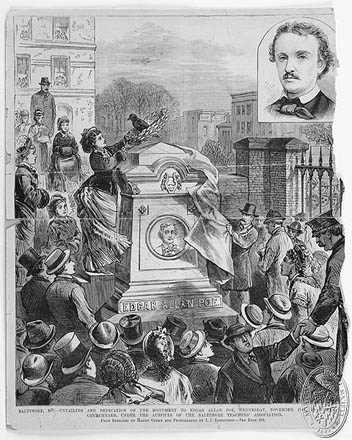
the reburial of Edgar Allan Poe, November 17, 1875


Poe was originally buried without a headstone towards the rear corner of the churchyard near his grandfather, David Poe, Sr. A headstone of white Italian marble, paid for by Poe's cousin Neilson Poe, was destroyed before it reached the grave when a train derailed and plowed through the monument yard where it was being kept. Instead, it was marked with a sand-stone block that read "No. 80". In 1873, Southern poet Paul Hamilton Hayne visited Poe's grave and published a newspaper article describing its poor condition and suggesting a more appropriate monument. Sara Sigourney Rice, a teacher in Baltimore's public schools, took advantage of renewed interest in Poe's grave site and personally solicited for funds. She even had some of her elocution students give public performances to raise money. Many in Baltimore and throughout the United States contributed; the final $650 came from Philadelphia publisher and philanthropist George William Childs. The new monument was designed by architect George A. Frederick and built by Colonel Hugh Sisson, and included a medallion of Poe by artist Adalbert Volck. All three men were from Baltimore. The total cost of the monument, with the medallion, amounted to slightly more than $1,500.

Poe was reburied on October 1, 1875, at a new location close to the front of the church. A celebration was held at the dedication of the new tomb on November 17. His original burial spot was marked with a large stone donated by Orin C. Painter, though it was originally placed in the wrong spot. Attendees included Neilson Poe, who gave a speech and called his cousin "one of the best hearted men that ever lived", as well as Nathan C. Brooks, John Snodgrass, and John Hill Hewitt. Though several leading poets were invited to the ceremony, Walt Whitman was the only one to attend. Alfred Tennyson contributed a poem which was read at the ceremony:

Fate that once denied him,
And envy that once decried him,
And malice that belied him,
Now cenotaph his fame.


Probably unknown to the reburial crew, the headstones on all the graves, previously facing to the east, had been turned to face the West Gate in 1864. The crew digging up Poe's remains had difficulty finding the right body: they first exhumed a 19-year old Maryland militiaman, Philip Mosher, Jr. When they correctly located Poe, they opened his coffin and one witness noted: "The skull was in excellent condition—the shape of the forehead, one of Poe's striking features, was easily discerned."


A few years later, the remains of Poe's wife, Virginia, were moved to this spot as well. In 1875, the cemetery in which she lay was destroyed, and she had no kin to claim her remains. William Gill, an early Poe biographer, gathered her bones and stored them in a box he hid under his bed. Virginia's remains were finally buried with her husband's on January 19, 1885, the 76th anniversary of her husband's birth and nearly 10 years after his present monument was erected. George W. Spence, the man who served as sexton during Poe's original burial as well as his exhumation and reburial, attended the rites that brought his body to rest with Virginia and Virginia's mother, Maria Clemm.


(source)

Monday, September 23, 2013

John Keats (1795-1821), "To Autumn" (September 19, 1819)

                                           1.
    SEASON of mists and mellow fruitfulness,
        Close bosom-friend of the maturing sun;
    Conspiring with him how to load and bless
        With fruit the vines that round the thatch-eves run;
    To bend with apples the moss’d cottage-trees,
        And fill all fruit with ripeness to the core;
            To swell the gourd, and plump the hazel shells
    With a sweet kernel; to set budding more,
        And still more, later flowers for the bees,
        Until they think warm days will never cease,
            For Summer has o’er-brimm’d their clammy cells.

                                            2.
    Who hath not seen thee oft amid thy store?
        Sometimes whoever seeks abroad may find
    Thee sitting careless on a granary floor,
        Thy hair soft-lifted by the winnowing wind;
    Or on a half-reap’d furrow sound asleep,
        Drows’d with the fume of poppies, while thy hook
            Spares the next swath and all its twined flowers:
    And sometimes like a gleaner thou dost keep
        Steady thy laden head across a brook;
        Or by a cyder-press, with patient look,
            Thou watchest the last oozings hours by hours.

                                            3.
    Where are the songs of Spring? Ay, where are they?
        Think not of them, thou hast thy music too,—
    While barred clouds bloom the soft-dying day,
        And touch the stubble plains with rosy hue;
    Then in a wailful choir the small gnats mourn
        Among the river sallows, borne aloft
            Or sinking as the light wind lives or dies;
    And full-grown lambs loud bleat from hilly bourn;
        Hedge-crickets sing; and now with treble soft
        The red-breast whistles from a garden-croft;
           And gathering swallows twitter in the skies.

Monday, September 9, 2013

'For the Anniversary of John Keats's Death (February 23, 1821)'

At midnight when the moonlit cypress trees
Have woven round his grave a magic shade,
Still weeping the unfinished hymn he made,
There moves fresh Maia like a morning breeze
Blown over jonquil beds when warm rains cease.
And stooping where her poet's head is laid,
Selene weeps while all the tides are stayed
And swaying seas are darkened into peace.
But they who wake the meadows and the tides
Have hearts too kind to bid him wake from sleep
Who murmurs sometimes when his dreams are deep,
Startling the Quiet Land where he abides,
And charming still, sad-eyed Persephone
With visions of the sunny earth and sea.

- Sara Teasdale, Helen of Troy and Other Poems (1911)

the most wonderful time of the year


I love this so much I can even forgive them spelling Poe's name wrong.

Friday, August 30, 2013

So. The Spear-Danes in days gone by

There's a meme going around (a meme I actually DON'T HATE, good heavens), "post your favourite Seamus Heaney poem," and while I wish people (including me) wouldn't just do this when somebody dies, here's mine. I guess it's a total cliche, but I loved his Beowulf -- how slangy and grand it was, all the things that pissed off the purists. I wonder what Tolkien would have made of it.

Shield was still thriving when his time came
And he crossed over into the Lord’s keeping.
His warrior band did what he bade them
When he laid down the law among the Danes:
They shouldered him out to the sea’s flood,                                    
The chief they revered who had long ruled them.
A ring-whorled prow rode in the harbour,
Ice-clad, outbound, a craft for a prince.
They stretched their beloved lord in his boat,
Laid out by the mast, amidships,
The great ring-giver.  Far-fetched treasures
Were piled upon him, and precious gear.
I never heard before of a ship so well furbished
With battle tackle, bladed weapons
And coats of mail.  The massed treasure                                
Was loaded on top of him: it would travel far
On out into the ocean’s sway.
They decked his body no less bountifully
With offerings than those first ones did
Who cast him away when he was a child
And launched him alone out over the waves.
And they set a gold standard up
High above his head and let him drift
To wind and tide, bewailing him
And mourning their loss.  No man can tell,                                     
No wise man in hall or weathered veteran
Knows for certain who salvaged that load.
Michael Cavna, 'Seamus Heaney: A Man of His Word'

Tuesday, April 2, 2013

if there's a way out it will be / step by step through the black

Transcendental musical experiences that are not wearing out: the last verse of "Riding with the Ghost" ("I put my foot to the floor to make up for the miles I've been losing / I've been running out of things I didn't even know I was using") and the last thundering two minutes of "Farewell Transmission" with the wailing guitars and crooning chorus and drums all dying out to the final repeated commands: "Listen!.....Listen!.....Listen!" and then the music stops.

(Dammit, Jason.)