
descensus Averno facilis est
Wednesday, November 6, 2013
Tuesday, November 5, 2013
more Anne Carson on Emily Brontë
....Charlotte’s preface to Wuthering Heights is a publicist’s masterpiece.
- "The Glass Essay"
Like someone carefully not looking at a scorpion
crouched on the arm of the sofa Charlotte
talks firmly and calmly
about the other furniture of Emily’s workshop—about
the inexorable spirit (“stronger than a man, simpler than a child”),
the cruel illness (“pain no words can render”),
the autonomous end (“she sank rapidly, she made haste to leave us”)
and about Emily’s total subjection
to a creative project she could neither understand nor control,
and for which she deserves no more praise nor blame
than if she had opened her mouth
“to breathe lightning.” The scorpion is inching down
the arm of the sofa while Charlotte
continues to speak helpfully about lightning
and other weather we may expect to experience
when we enter Emily’s electrical atmosphere.
It is “a horror of great darkness” that awaits us there
but Emily is not responsible. Emily was in the grip.
“Having formed these beings she did not know what she had done,”
says Charlotte (of Heathcliff and Earnshaw and Catherine).
Well there are many ways of being held prisoner.
The scorpion takes a light spring and lands on our left knee
as Charlotte concludes, “On herself she had no pity.”
- "The Glass Essay"

Katha Pollitt on Adrienne Rich
In 1963, the year Betty Friedan published “The Feminine Mystique,”
Rich published her first great book, “Snapshots of a Daughter-in-Law,”
with its indelible title sequence:
- via
(Compare and contrast with Ange Mlinko, sleekly self-satisfied as Katie Roiphe, chastising Rich for being so glum and fragmentary, and not, God help us all, playful enough. “No surprise for the writer, no surprise for the reader,” Robert Frost warned; I thought of this maxim more than once....I thought of Wallace Stevens’s distinction between the poetry of war and....I thought of Keats writing....I thought of Sir Philip Sidney.... -- what the hell.) (Did you even notice that all the poets you chose were male? Did you even notice you are buying right into the old, old argument that women are subjective and ranting and not concerned with the Real World, unlike, well, Robert Frost and Wallace Stevens and Keats and....Sir Philip Sidney? Really? What, are you trying to impress Harold Bloom for some reason?)
A thinking woman sleeps with monsters.This is poetry that is literally unforgettable, that memorizes itself. It is astonishing how much of the still-to-come feminist revolution Rich foreshadowed in these still-early poems: not just the rage of a brilliant woman at being forced into a lesser, false, infantilized life, but a tough, unsparing insight into its seductions: “our blight has been our sinecure: / mere talent was enough for us— / glitter in fragments and rough drafts.” Friedan made much the same points, but, because her book was topical journalism, it feels dated today: it is hard to use Friedan to convey to students, say, why a middle-class educated suburban housewife in the nineteen-fifties might have been restless and miserable, because for most young people the specifics of that life are too old and musty and alien; you might as well try to convey the world of a Roman matron or a medieval nun. But Rich’s poetry from this era still carries the shock of recognition, because it is about the deeper truths of consciousness behind the period details and interviews and statistics...
The beak that grips her, she becomes. And Nature,
that sprung-lidded, still commodious
steamer-trunk of tempora and mores
gets stuffed with it all: the mildewed orange-flowers,
the female pills, the terrible breasts
of Boadicea beneath flat foxes’ heads and orchids.
- via
(Compare and contrast with Ange Mlinko, sleekly self-satisfied as Katie Roiphe, chastising Rich for being so glum and fragmentary, and not, God help us all, playful enough. “No surprise for the writer, no surprise for the reader,” Robert Frost warned; I thought of this maxim more than once....I thought of Wallace Stevens’s distinction between the poetry of war and....I thought of Keats writing....I thought of Sir Philip Sidney.... -- what the hell.) (Did you even notice that all the poets you chose were male? Did you even notice you are buying right into the old, old argument that women are subjective and ranting and not concerned with the Real World, unlike, well, Robert Frost and Wallace Stevens and Keats and....Sir Philip Sidney? Really? What, are you trying to impress Harold Bloom for some reason?)
actually my favourite part of that Toast 'male novelists' piece....
....was the brilliant satirical comment impersonating a clueless self-satisfied white male beardo who thinks the world revolves around Terry Pratchett and Douglas Adams and substituted "Charles Dickens" at the last moment for "George R.R. Martin" because that would have put it over the --
-- wait
....DAMN.
REAL LIFE: //once again beats satire like a redheaded stepchild, satire goes home to throw herself on the divan and sob and eat Ferrero Rochers out of the box

-- wait
....DAMN.
REAL LIFE: //once again beats satire like a redheaded stepchild, satire goes home to throw herself on the divan and sob and eat Ferrero Rochers out of the box

Monday, November 4, 2013
faustus!
OMG what the hell is up with the mimes/scholars/dancing extras holding the books. Still, fan-fucking-tastic.
ill-met by moonlight
Julie Taymor usually gives me the pip, and a lot of these are too goddamn Cirque du Soleil, but some of the staging is gorgeous.


DAMN, I COULD HAVE GOTTEN THIS FOR MY BIRTHDAY

Oh well day-late birthday present it is then! -- I just wish they offered an Anne Sexton shirt too -- Transformations maybe, those Barbara Swan lithographs are so beautiful. Anne is now so eclipsed by Sylvia -- that wouldn't have made her happy at all. But at least she got her (Crazy Lady Poet) Pulitzer while she was still alive.
(Or how about a Shirley Jackson mental health T-shirt -- white lettering on black? 'No live organism can continue for long to exist sanely under conditions of absolute reality; even larks and katydids are supposed, by some, to dream.') (You KNOW there's a huge market of all the sad literary young girls out there....)
Sunday, November 3, 2013
"Assurance," William Stafford
You will never be alone, you hear so deep
a sound when autumn comes. Yellow
pulls across the hills and thrums,
or the silence after lightning before it says
its names- and then the clouds' wide-mouthed
apologies. You were aimed from birth:
you will never be alone. Rain
will come, a gutter filled, an Amazon,
long aisles- you never heard so deep a sound,
moss on rock, and years. You turn your head-
that’s what the silence meant: you’re not alone.
The whole wide world pours down.
Saturday, November 2, 2013
'Sylvia Plath's Joy'
A time of day, dawn, made sharp by anticipated interruption; a house
animated by children, their happiness, their demands, their balloons and
playthings; the potential for violence innate in all beauty, as well as
the awful beauty of violence; the feeling of elation at filling a house
with the clacking of a typewriter, and the fear of the silence when the
typing ends: these elements are my personal “Ariel,” and I tire of the
more rhetorical and showy poems—“Daddy,” “The Applicant,” “Lady
Lazarus”—upon which Plath made her notorious name. “Ariel” ends with a
poem, “Words,” about the season that T. S. Eliot called “midwinter
spring” and Wallace Stevens called “the earliest end of winter”: March,
when, in New England (a region all three poets share), the sap runs.
Plath’s keystrokes in the quiet house are like “Axes / After whose
stroke the wood rings.” Before, echoing away from her, they become like
horses’ “indefatigable hoof taps”—“riderless,” as in a funeral
procession. Add to the available accounts of Plath (there are so many)
this, please: nobody brought a house to life the way she did. “Ariel,”
despite the tragedy that attends it, is a book with much joy between its
covers.
- Dan Chiasson
- Dan Chiasson
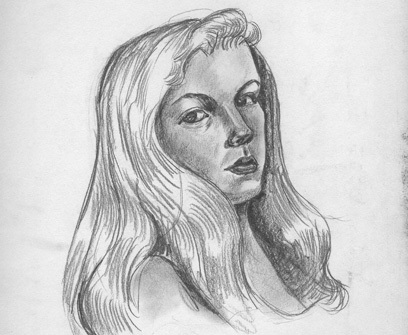 |
| Sylvia Plath, self-portrait |
one of the best websites ever
Though owning any book once in the possession of a beloved writer is a rather cool thing in and of itself, the aspect of this treasure that so enthralls these mad Marksonites—myself included—is the fact that Markson wrote in a large number of these books. In some maybe there’s nothing more than his inscription and a checkmark or two, but in others he seems to have whole dialogues with the text in the margins. Is he talking to the author? Is he talking to himself? Is he talking to some future reader who would inevitably pick up these books once he was dead and they were donated to The Strand in accordance with his wishes? Is he talking to me? To you?
The ability to gaze into the private literary life of one of the great unsung literary heroes of our day and see him reacting to what he reads is a unique pleasure (so rarely afforded to us). And since Markson’s writing was so informed by his reading—especially his late tetralogy (The Notecard Quartet, as those last four novels have been called) which is filled wholly with the cultural detritus he’d pick up from his voracious reading—it is more than a mere delight to read Markson reading, it is indispensable to any study of the man and his work.
Reading Markson Reading
"A Nice Cup of Tea," By George Orwell
Evening Standard, 12 January 1946.
If you look up 'tea' in the first cookery book that comes to hand you will probably find that it is unmentioned; or at most you will find a few lines of sketchy instructions which give no ruling on several of the most important points.
This is curious, not only because tea is one of the main stays of civilization in this country, as well as in Eire, Australia and New Zealand, but because the best manner of making it is the subject of violent disputes.
When I look through my own recipe for the perfect cup of tea, I find no fewer than eleven outstanding points. On perhaps two of them there would be pretty general agreement, but at least four others are acutely controversial. Here are my own eleven rules, every one of which I regard as golden:
(from The Collected Essays, Journalism and Letters of George Orwell, Volume 3, 1943-45)
via
If you look up 'tea' in the first cookery book that comes to hand you will probably find that it is unmentioned; or at most you will find a few lines of sketchy instructions which give no ruling on several of the most important points.
This is curious, not only because tea is one of the main stays of civilization in this country, as well as in Eire, Australia and New Zealand, but because the best manner of making it is the subject of violent disputes.
When I look through my own recipe for the perfect cup of tea, I find no fewer than eleven outstanding points. On perhaps two of them there would be pretty general agreement, but at least four others are acutely controversial. Here are my own eleven rules, every one of which I regard as golden:
- First of all, one should use Indian or Ceylonese tea. China tea has virtues which are not to be despised nowadays — it is economical, and one can drink it without milk — but there is not much stimulation in it. One does not feel wiser, braver or more optimistic after drinking it. Anyone who has used that comforting phrase 'a nice cup of tea' invariably means Indian tea.
- Secondly, tea should be made in small quantities — that is, in a teapot. Tea out of an urn is always tasteless, while army tea, made in a cauldron, tastes of grease and whitewash. The teapot should be made of china or earthenware. Silver or Britanniaware teapots produce inferior tea and enamel pots are worse; though curiously enough a pewter teapot (a rarity nowadays) is not so bad.
- Thirdly, the pot should be warmed beforehand. This is better done by placing it on the hob than by the usual method of swilling it out with hot water.
- Fourthly, the tea should be strong. For a pot holding a quart, if you are going to fill it nearly to the brim, six heaped teaspoons would be about right. In a time of rationing, this is not an idea that can be realized on every day of the week, but I maintain that one strong cup of tea is better than twenty weak ones. All true tea lovers not only like their tea strong, but like it a little stronger with each year that passes — a fact which is recognized in the extra ration issued to old-age pensioners.
- Fifthly, the tea should be put straight into the pot. No strainers, muslin bags or other devices to imprison the tea. In some countries teapots are fitted with little dangling baskets under the spout to catch the stray leaves, which are supposed to be harmful. Actually one can swallow tea-leaves in considerable quantities without ill effect, and if the tea is not loose in the pot it never infuses properly.
- Sixthly, one should take the teapot to the kettle and not the other way about. The water should be actually boiling at the moment of impact, which means that one should keep it on the flame while one pours. Some people add that one should only use water that has been freshly brought to the boil, but I have never noticed that it makes any difference.
- Seventhly, after making the tea, one should stir it, or better, give the pot a good shake, afterwards allowing the leaves to settle.
- Eighthly, one should drink out of a good breakfast cup — that is, the cylindrical type of cup, not the flat, shallow type. The breakfast cup holds more, and with the other kind one's tea is always half cold before one has well started on it.
- Ninthly, one should pour the cream off the milk before using it for tea. Milk that is too creamy always gives tea a sickly taste.
- Tenthly, one should pour tea into the cup first. This is one of the most controversial points of all; indeed in every family in Britain there are probably two schools of thought on the subject. The milk-first school can bring forward some fairly strong arguments, but I maintain that my own argument is unanswerable. This is that, by putting the tea in first and stirring as one pours, one can exactly regulate the amount of milk whereas one is liable to put in too much milk if one does it the other way round.
- Lastly, tea — unless one is drinking it in the Russian style —
should be drunk without sugar. I know very well that I am in a minority
here. But still, how can you call yourself a true tealover if you destroy
the flavour of your tea by putting sugar in it? It would be equally reasonable
to put in pepper or salt. Tea is meant to be bitter, just as beer is meant
to be bitter. If you sweeten it, you are no longer tasting the tea, you are
merely tasting the sugar; you could make a very similar drink by dissolving
sugar in plain hot water.
Some people would answer that they don't like tea in itself, that they only drink it in order to be warmed and stimulated, and they need sugar to take the taste away. To those misguided people I would say: Try drinking tea without sugar for, say, a fortnight and it is very unlikely that you will ever want to ruin your tea by sweetening it again.
(from The Collected Essays, Journalism and Letters of George Orwell, Volume 3, 1943-45)
via
the raven
One thing readers may not see a lot of in the next few days is much
attention to Reed’s serious connections to the poetry world, or his role
in the history of poetry itself. But the fact is Reed and the Velvet
Underground not only emerged out of the cauldron of the early-1960s
avant-garde literature and art, but had close links to currents in
postwar American poetry. More so than many casual music fans or
aficionados of American poetry might realize, Reed’s body of work
represents a crucial but overlooked instance of poetry’s rich
back-and-forth dialogue with popular culture.
- Poetry
- Poetry
'yours in liminality'
In almost all forms of art, the monstrous feminine must be vanquished. She sticks around for awhile, letting us gaze upon and be fascinated by her, but her death is an absolute necessity if patriarchal order is to be restored. But things aren’t so simple in American Horror Story. It offers the basic abject pleasures of the horror genre, but it refuses to cooperate with the processes that call for the ultimate rejection of those pleasures. It screws with the processes that sustain the symbolic order — with the “Law of the Father,” as Jacques Lacan would put it, with patriarchy.
....American Horror Story disregards hierarchies. It signifies as one thing and is another. It is, in other words, abject as hell. Which is precisely why it inspires the reactions it does: it’s addictive yet embarrassing; you love and hate it, can’t decide if it’s sympathetic or predatory, misogynistic or feminist. Fiona is a shameless ball-buster, but she’s also terrified by her own aging body, beholden to societal understandings of what “beauty” and “vitality” look like. Even as the “Supreme,” her power only extends so far: she can decimate men, but she can’t decimate patriarchal ideology. Those sorts of nuanced contradictions function as AHS’s narrative engine: it feeds on them, explores and explodes them.
- LARB
Fuck yeah that's my show.

happiness
Aww, nice picture of Elliott (by Marina Chavez)....It's now a cliche how tormented they were (ho, ho! mental illness, SO FUNNY) but you never, OK, I never, realized how few pictures there are of him -- and Kurt Cobain too -- really smiling. And I love the big blank space above him, too, like a heaven, and the pack of Camels, the stained curb, the bunny-tied laces.


'No one will thank you for a doze in such a den!'
This time, I remembered I was lying in the oak closet, and I heard distinctly the gusty wind, and the driving of the snow; I heard, also, the fir bough repeat its teasing sound, and ascribed it to the right cause: but it annoyed me so much, that I resolved to silence it, if possible; and, I thought, I rose and endeavoured to unhasp the casement. The hook was soldered into the staple: a circumstance observed by me when awake, but forgotten. ‘I must stop it, nevertheless!’ I muttered, knocking my knuckles through the glass, and stretching an arm out to seize the importunate branch; instead of which, my fingers closed on the fingers of a little, ice-cold hand! The intense horror of nightmare came over me: I tried to draw back my arm, but the hand clung to it, and a most melancholy voice sobbed, ‘Let me in—let me in!’ ‘Who are you?’ I asked, struggling, meanwhile, to disengage myself. ‘Catherine Linton,’ it replied, shiveringly (why did I think of Linton? I had read Earnshaw twenty times for Linton)—‘I’m come home: I’d lost my way on the moor!’ As it spoke, I discerned, obscurely, a child’s face looking through the window. Terror made me cruel; and, finding it useless to attempt shaking the creature off, I pulled its wrist on to the broken pane, and rubbed it to and fro till the blood ran down and soaked the bedclothes: still it wailed, ‘Let me in!’ and maintained its tenacious gripe, almost maddening me with fear. ‘How can I!’ I said at length. ‘Let me go, if you want me to let you in!’ The fingers relaxed, I snatched mine through the hole, hurriedly piled the books up in a pyramid against it, and stopped my ears to exclude the lamentable prayer. I seemed to keep them closed above a quarter of an hour; yet, the instant I listened again, there was the doleful cry moaning on! ‘Begone!’ I shouted. ‘I’ll never let you in, not if you beg for twenty years.’ ‘It is twenty years,’ mourned the voice: ‘twenty years. I’ve been a waif for twenty years!’ Thereat began a feeble scratching outside, and the pile of books moved as if thrust forward. I tried to jump up; but could not stir a limb; and so yelled aloud, in a frenzy of fright. To my confusion, I discovered the yell was not ideal: hasty footsteps approached my chamber door; somebody pushed it open, with a vigorous hand, and a light glimmered through the squares at the top of the bed. I sat shuddering yet, and wiping the perspiration from my forehead: the intruder appeared to hesitate, and muttered to himself. At last, he said, in a half-whisper, plainly not expecting an answer, ‘Is any one here?’- Wuthering Heights
(I will forever maintain this is the passage Charlotte is talking about when she 'complained that the mere hearing of certain vivid and fearful scenes banished sleep by night, and disturbed mental peace by day'.) (And you can just hear Emily: "What? It isn't real, you know -- " "You know when I can't sleep, I get those awful headaches!")


'Un dessein si funeste, S'il n'est digne d'Atree, est digne de Thyeste.'
"You will now understand what I
meant in suggesting that, had the purloined letter been hidden
anywhere within the limits of the Prefect's examination --in other
words, had the principle of its concealment been comprehended within
the principles of the Prefect --its discovery would have been a matter
altogether beyond question. This functionary, however, has been
thoroughly mystified; and the remote source of his defeat lies in
the supposition that the Minister is a fool, because he has acquired
renown as a poet. All fools are poets; this the Prefect feels; and
he is merely guilty of a non distributio medii in thence inferring
that all poets are fools."
- Edgar Allan Poe, "The Purloined Letter"
- Edgar Allan Poe, "The Purloined Letter"
Sylvia Plath's (fictional) typewriter
As seen in Warehouse 13 (this cracked me up for over a minute):


One of Plath's actual typewriters:


One of Plath's actual typewriters:
Friday, November 1, 2013
Diane Arbus, Untitled (Marcella Matthaei), 1969

“All families are creepy in a way,” Arbus wrote to a friend in 1968.
(Awesomely: "The only recollection I have of her is that I mistakenly thought she was Joan Baez," says Marcella, who lives in Florida now and describes herself as a part-time writer and part-time construction worker. "She was slender and pretty and my father had a Joan Baez album. I thought it was her.")
(I don't know why I love this photo so much, really. It reminds me a bit of Munch's girl in "Puberty," altho the two artworks are really different. But that same gaze, that same no-bullshit engaging with the viewer.)
what I'm reading
It never occurred to me not to go; nor did it occur to me to tell Alice Lee Langman I was going -- she came home from the dentist to find I had packed and gone. I didn't say good-bye to anybody, just left; I'm the type, and a type by no means rare, who might be your closest friend, a buddy you talked to every day, yet if one day you neglected to make contact, if you failed to telephone me, then that would be it, we'd never speak again, for I would never telephone you. I've known lizard-bloods like that and never understood them, even though I was one myself. Just left, yes: sailed at midnight, my heartbeat as raucous as the clanging gongs, the hoarsely hollering smokestacks. I remember watching Manhattan's midnight shine flicker and darken through shivering streamers of confetti -- lights I was not to see again for twelve years. And I remember, as I swayed my way down to a tourist-class cabin (having exchanged the first-class passage and pocketed the difference), I remember slipping in a mess of champagne vomit and dislocating my neck. Pity I didn't break it.
-- Truman Capote, Answered Prayers ("Unspoiled Monsters")
-- Truman Capote, Answered Prayers ("Unspoiled Monsters")
Here lies One Whose Name was writ in Water
Aww damn, I got so wrapped up in Poe I forgot to celebrate my boy's birthday!
Robert Graves was frequently a nutjob, but he was almost always spot-on about poetry. From "The Grosser Senses," in The Common Asphodel:
Shelley was a volatile creature of air and fire: he seems never to have noticed what he ate or drank, except sometimes as a matter of vegetarian principle. Keats was earthy, with a sweet tooth and a relish for spices, cream and snuff, and in a letter mentions peppering his own tongue to bring out the delicious coolness of claret.
....When Shelley in Prometheus Unbound mentions:
he does not conjure up, as Keats would have done, the taste of the last hot days of the dying English year, with over-ripe blackberries, ditches full of water, and the hedges grey with old man’s beard. He is not aware of the veteran bees whirring their frayed wings or sucking rank honey from the dusty yellow blossoms of the ivy.
And surely Graves means us to think of the stunning opening of the ode "To Autumn":
SEASON of mists and mellow fruitfulness,
Close bosom-friend of the maturing sun;
Conspiring with him how to load and bless
With fruit the vines that round the thatch-eaves run;
To bend with apples the moss’d cottage-trees,
And fill all fruit with ripeness to the core;
To swell the gourd, and plump the hazel shells
With a sweet kernel; to set budding more,
And still more, later flowers for the bees,
Until they think warm days will never cease;
For Summer has o’erbrimm’d their clammy cells.
Robert Graves was frequently a nutjob, but he was almost always spot-on about poetry. From "The Grosser Senses," in The Common Asphodel:
Shelley was a volatile creature of air and fire: he seems never to have noticed what he ate or drank, except sometimes as a matter of vegetarian principle. Keats was earthy, with a sweet tooth and a relish for spices, cream and snuff, and in a letter mentions peppering his own tongue to bring out the delicious coolness of claret.
....When Shelley in Prometheus Unbound mentions:
The yellow bees in the ivy-bloom,
he does not conjure up, as Keats would have done, the taste of the last hot days of the dying English year, with over-ripe blackberries, ditches full of water, and the hedges grey with old man’s beard. He is not aware of the veteran bees whirring their frayed wings or sucking rank honey from the dusty yellow blossoms of the ivy.
And surely Graves means us to think of the stunning opening of the ode "To Autumn":
SEASON of mists and mellow fruitfulness,
Close bosom-friend of the maturing sun;
Conspiring with him how to load and bless
With fruit the vines that round the thatch-eaves run;
To bend with apples the moss’d cottage-trees,
And fill all fruit with ripeness to the core;
To swell the gourd, and plump the hazel shells
With a sweet kernel; to set budding more,
And still more, later flowers for the bees,
Until they think warm days will never cease;
For Summer has o’erbrimm’d their clammy cells.
Handwritten draft from Truman Capote's 'Answered Prayers'

'Capote's Swan Dive,' Sam Kashner:
There was a memory that Truman liked to relate, about a husky boy from his childhood in Monroeville, Alabama, who spent an entire summer digging a hole in his backyard. “Why’re you doing that?” Truman had asked. “To get to China. See, the other side of this hole, that’s China.” Truman would later write, “Well, he never got to China; and maybe I’ll never finish Answered Prayers; but I keep on digging! All the best, T.C.”
books read in November 2013
Fiction is in red.
189. An Emergency in Slow Motion: The Inner Life of Diane Arbus, William Todd Schultz
190. Tiny Terror: Why Truman Capote (Almost) Wrote Answered Prayers (Inner Lives), William Todd Schultz (better than the Arbus monograph, not as good as the Elliott Smith biography)
191. The Last Place, Laura Lippman (Tess Monaghan is my new girlfriend)
192. The Sugar House, Laura Lippman
193. Reasonable Creatures: Essays on Women and Feminism, Katha Pollitt
194. The Lady and Her Monsters: A Tale of Dissections, Real-Life Dr. Frankensteins, and the Creation of Mary Shelley's Masterpiece, Roseanne Montillo
195. Answered Prayers, Truman Capote
196. Devotion: A Memoir, Dani Shapiro
197. Still Writing: The Pleasures and Perils of a Creative Life, Dani Shapiro
198. This Is the Story of a Happy Marriage, Ann Patchett
199. The Lies of Locke Lamora, Scott Lynch (amazingly awful)
200. Black & White, Dani Shapiro (ditto)
201. The Disaster Artist: My Life Inside The Room, the Greatest Bad Movie Ever Made, Greg Sestero
202. Raising Steam, Terry Pratchett
203. The Lost Bank: The Story of Washington Mutual, Kirsten Grind
204. Flannery: A Life of Flannery O'Connor, Brad Gooch
2013 booklist
189. An Emergency in Slow Motion: The Inner Life of Diane Arbus, William Todd Schultz
190. Tiny Terror: Why Truman Capote (Almost) Wrote Answered Prayers (Inner Lives), William Todd Schultz (better than the Arbus monograph, not as good as the Elliott Smith biography)
191. The Last Place, Laura Lippman (Tess Monaghan is my new girlfriend)
192. The Sugar House, Laura Lippman
193. Reasonable Creatures: Essays on Women and Feminism, Katha Pollitt
194. The Lady and Her Monsters: A Tale of Dissections, Real-Life Dr. Frankensteins, and the Creation of Mary Shelley's Masterpiece, Roseanne Montillo
195. Answered Prayers, Truman Capote
196. Devotion: A Memoir, Dani Shapiro
197. Still Writing: The Pleasures and Perils of a Creative Life, Dani Shapiro
198. This Is the Story of a Happy Marriage, Ann Patchett
199. The Lies of Locke Lamora, Scott Lynch (amazingly awful)
200. Black & White, Dani Shapiro (ditto)
201. The Disaster Artist: My Life Inside The Room, the Greatest Bad Movie Ever Made, Greg Sestero
202. Raising Steam, Terry Pratchett
203. The Lost Bank: The Story of Washington Mutual, Kirsten Grind
204. Flannery: A Life of Flannery O'Connor, Brad Gooch
2013 booklist
Subscribe to:
Posts (Atom)