Tuesday, November 19, 2013

horrid mysteries


salvage: 'wrecks into art'

The world's most important archive of original shipwreck photographs has been saved for the nation by the National Maritime Museum.
Virtually all 1700 mainly 19th and early 20th century glass plate negatives, conventional film  negatives and silver print positive photographs were taken  by successive generations of a family of photographers based on the Isles of Scilly. (source)

Fragment 31

He seems to me equal to gods that man
whoever he is who opposite you
sits and listens close
           to your sweet speaking

and lovely laughing—oh it
puts the heart in my chest on wings
for when I look at you, even a moment, no speaking
           is left in me

no: tongue breaks and thin
fire is racing under skin
and in eyes no sight and drumming
           fills ears

and cold sweat holds me and shaking
grips me all, greener than grass
I am and dead—or almost
           I seem to me.

But all is to be dared, because even a person of poverty

- Sappho, tr. Anne Carson


("In the poem Sappho doesn’t use the word ecstasy, but she talks about herself as standing outside herself and observing her own condition. It sounds as if she’s achieving the state of standing outside one’s own soul that constitutes ecstasy, but which also constitutes what many mystics strive to achieve in canceling their selfhood so that they can be empty vessels for God. I don’t think Sappho has that idea as such—it’s an anachronism to ascribe it to her—but I do think there is a deep spiritual substance to Sappho’s descriptions of gods and our relation to gods that ought to be taken account of in reading her poetry. But I don’t exactly know how.")

via

'continues to be like a harbor always welcoming'

CARSON
....At least half of your mind is always thinking, I’ll be leaving; this won’t last. It’s a good Buddhist attitude. It prepares you for life as a Buddhist. If I were a Buddhist, this would be a great help. As it is, I’m just sad.

INTERVIEWER
You would be well on the road to enlightenment if you were a Buddhist.

CARSON
Instead, I’ve avoided enlightenment resolutely.

INTERVIEWER
I’d like to talk a little bit about your discovery of ancient Greece. You first started studying Greek in high school?

CARSON
Yes. Grade thirteen.

INTERVIEWER
Was it immediately apparent that it was changing your life?

CARSON
Yes, immediately. Mrs. Cowan started to teach me Greek—she was our Latin teacher in high school, in Port Hope—but she also knew Greek, so she offered to teach me because she found out I was interested in it, so we did it on our lunch hour.

INTERVIEWER
There wasn’t a Greek class?

CARSON
No. No one was interested except me. We read Sappho together, and it was simply revolutionary. I don’t know every language in the world—maybe if I knew Sanskrit and Chinese I would think differently—but there’s something about Greek that seems to go deeper into words than any modern language. So that when you’re reading it, you’re down in the roots of where words work, whereas in English we’re at the top of the tree, in the branches, bouncing around. It was stunning to me, a revelation. And it continues to be stunning, continues to be like a harbor always welcoming. Strange, but welcoming.

INTERVIEWER
That must be really nice, to have that place to go to.

CARSON
It is. I’m sure it’s part of what mental health I have. A large part. It’s a home. It’s a home in my mind. And then to be able to make my living at it is a great benevolence of the universe.

INTERVIEWER
A lot of people say the ancient Greeks are really our contemporaries. Spiritually, I mean.

CARSON
I don’t feel much direct relevance of ancient things to modern things. It was the temper of the times, especially in the seventies and eighties when I was getting my degree and teaching, to claim that the project of being a classicist was to find relevance to antiquity and invent courses that convinced students that you could learn everything you needed to know about modern life from studying the ancient Greeks. Well, this is bizarre, to say the least. What’s entrancing about the Greeks is that you get little glimpses, little latches of similarity, embedded in unbelievable otherness, in this huge landscape of strange convictions about the world and reactions to life that make no sense at all.

INTERVIEWER
So there’s this dense otherness that you just want to find out about. Whether it’s relevant is besides the point.

CARSON
One thing I do understand about the Greeks is that they, too, understood this and valued it. That is what the god Dionysus is as a principle—the principle of being up against something so other that it bounces you out of yourself to a place where, nonetheless, you are still in yourself; there’s a connection to yourself as another. It’s what they call "ecstasy." The Greeks invented this concept, but they also embody it for us, which may just be just our utilitarian approach to them. But who can say. We are always going to be looking at the Greeks and figuring out who they are in relation to what we are. We can’t get out and be in a third place and judge both of us.

INTERVIEWER
From a nice objective place?

CARSON
There is no objective place, just like there is no third gender; you’ve got to be in one place or the other.

- Anne Carson's Paris Review interview

red shoes


- Claudine Doury

PURE LOVE.

INTERVIEWER
I wonder if you could talk a little bit about your life as a gay man.

CARSON
It’s been a somewhat checkered career as a gay man. I was never totally successful. I think it started in high school, when in grade ten or eleven I developed a fascination with Oscar Wilde. Some of my friends shared this fascination so we used to dress like Oscar Wilde and memorize his aphorisms and construct conversations in the lunchroom, as if we were Oscar Wilde and his friends.
But I don’t know how it developed. I can’t exactly remember why I fixated on Oscar Wilde, but I did feel that it gave me an education in aesthetic sensibility, and also a kind of irony towards oneself that was useful in later life, an ongoing carapace of irony that I think lots of gay men develop in order to get through their social and personal lives, and which I found useful for myself, too.

INTERVIEWER
There are two places in your books where the persona is a gay man or a gay boy. There’s Autobiography of Red where Geryon falls in love with Heracles and the little ménage á trois in Peru and all that, but also “The Anthropology of Water” in Plainwater.

CARSON
Oh, you think that’s a man?

INTERVIEWER
You identify yourself as a man at one point.

CARSON
That’s the other thing about being a gay man. Model yourself on Oscar Wilde and you just lie all the time.

- Anne Carson

negative capability


"Don't worry you data is safe"


//just cries

Monday, November 18, 2013

retro

Read back through the archives of my own blog here (always a good exercise, if you can stand it) and some observations came to mind -

- the Tumblr-ization of this blog (tiny short quotes, lots of pictures, absolutely no context whatsoever) is still pretty fucking painful
- some of the UTU vids and linked photos are already beginning to disappear. (We don't need no more stinking archives, we have the internet, where everything is FOREVER!)
- my God, I used to write a helluva lot more than this, what happened? expectations of an audience? no audience? the wrong audience?
- and Jesus Harriet Christ, was my writing always this Lindy-West-lulzy? Has internet-speak just burrowed deep inside the furrows of my brain like a goddamn virtual worm and eaten the core right out of my language center?
- I really fucking need to stop rereading Terry Pratchett every other week
- I don't think a single doctor has ever taken me seriously about how my period makes me bedridden. Must fix this, now that Obamacare is here. Oh wait, it isn't? Is it? It's Schrödingercare (sp) by now.
- also really fucking need to find my Medicaid card
- and get my life in order
- like ten years ago
- that's never productive, stop that

(Shirley Jackson's haunting words, written in her journal near the end of her life: When I was twenty every year that went by was a triumph because it was getting me on toward growing up and really living, and now....if I pass my fiftieth year the chances of my dying of measles are very small, but the chances of my dying of....no, this is depressing. This is the kind of thinking I promised myself I would never do again.)

Autumn is my favourite season but the end of the year is so damned depressing, all that time piled up on your back and so little to actually show for it, all those promises you so brightly made at the beginning of last year, which time has almost circled back around to again, and the only thing that will happen is you'll make yourself a new pack of false resolutions you won't keep any more than you did the old ones. What a terrible idea, to have the new year begin in January, not with -- say -- the first snowfall, or even better, the very beginning of spring.

-- And THAT, folks, is why I take three (3) psychotropic medications in order to get out of bed in the morning, despite the Goodreader who shrieked at me my last day on that site, "MEDS: GET ON SOME. THEY CAN DO WONDERS, EVEN FOR YOU." Ah, virtual community. Well I lie, I woke up about an hour and a half ago (after crashing out at 9 PM, what am I, ninety?.....if not close, daily getting closer!), so I should take them right the hell now. J'excuse.

Saturday, November 16, 2013

Thursday, November 14, 2013

ἄνδρα μοι ἔννεπε, μοῦσα, πολύτροπον

The Man, O Muse, informe that many a way
Wound with his wisedome to his wished stay;
That wanderd wondrous farre when He the towne
Of sacred Troy had sackt and shiverd downe.
The cities of a world of nations,
With all their manners, mindes and fashions,
He saw and knew; at Sea felt many woes,
Much care sustaind, to save from overthrowes
Himselfe and friends in their retreate for home.
- George Chapman, 1616

The man for wisdom's various arts renown'd,
Long exercised in woes, O Muse! resound;
Who, when his arms had wrought the destined fall
Of sacred Troy, and razed her heaven-built wall,
Wandering from clime to clime, observant stray'd,
Their manners noted, and their states survey'd,
On stormy seas unnumber'd toils he bore,
Safe with his friends to gain his natal shore....
- Alexander Pope, 1725

Muse make the man thy theme, for shrewdness famed
And genius versatile, who far and wide
A Wand'rer, after Ilium overthrown,
Discover'd various cities, and the mind
And manners learn'd of men, in lands remote.
He num'rous woes on Ocean toss'd, endured,
Anxious to save himself, and to conduct
His followers to their home.
- William Cowper, 1791

Tell me, O Muse, of that ingenious hero who travelled far and wide after he had sacked the famous town of Troy. Many cities did he visit, and many were the nations with whose manners and customs he was acquainted; moreover he suffered much by sea while trying to save his own life and bring his men safely home....
- Samuel Butler, 1900

(Revised by Timothy Power and Gregory Nagy: Tell me, O Muse, of that many-sided hero who traveled far and wide after he had sacked the famous town of Troy. Many cities did he visit, and many were the people with whose customs and thinking he was acquainted; many things he suffered at sea while seeking to save his own life and to achieve the safe homecoming of his companions....)

Tell me, O Muse, of the man of many devices, who wandered full many ways after he had sacked the sacred citadel of Troy. Many were the men whose cities he saw and whose minds he learned, aye, and many the woes he suffered in his heart upon the sea, seeking to win his own life and the return of his comrades.
- A.T. Murray, 1919

Tell me, Muse, the story of that very resourceful man who was driven to wander far and wide after he had sacked the holy citadel of Troy. He saw the cities of many people and he learnt their ways. He suffered great anguish on the high seas in his struggles to preserve his life and bring his comrades home.
- Rieu, 1946

Sing in me, Muse, and through me tell the story
of that man skilled in all ways of contending,
the wanderer, harried for years on end,
after he plundered the stronghold
on the proud height of Troy.
          He saw the townlands
and learned the minds of many distant men,
and weathered many bitter nights and days
in his deep heart at sea, while he fought only
to save his life, to bring his shipmates home.
- Robert Fitzgerald, 1961

Tell me, Muse, of the man of many ways, who was driven
far journeys, after he had sacked Troy’s sacred citadel.
Many were they whose cities he saw, whose minds he learned of,
many the pains he suffered in his spirit on the wide sea,
struggling for his own life and the homecoming of his companions.
- Lattimore, 1965

Tell me, Muse, about the man of many turns, who many
Ways wandered when he had sacked Troy's holy citadel;
He saw the cities of many men, and he knew their thought;
On the ocean he suffered many pains within his heart,
Striving for his life and his companions' return.
- Cook, 1967

Muse, tell me of the man of many wiles,
the man who wandered many paths of exile
after he sacked Troy's sacred citadel.
He saw the cities—mapped the minds—of many;
and on the sea, his spirit suffered every
adversity—to keep his life intact,
to bring his comrades back.
- Allen Mandelbaum, 1990

Sing to me of the man, Muse, the man of twists and turns,
driven time and again off course, once he had plundered
the hallowed heights of Troy.
Many cities of men he saw and learned their minds,
Many pains he suffered, heartsick on the open sea,
fighting to save his life and bring his comrades home.
- Fagles, 1996

Muse, tell me of a man: a man of much resource, who was made to wander far and long, after he had sacked the sacred city of Troy. Many were the men whose lands he saw and came to know their thinking: many too the miseries at sea which he suffered in his heart, as he sought to win his own life and the safe return of his companions.
- Martin Hammond, 2000

Speak, Memory—
                                      Of the cunning hero,
The wanderer, blown off course time and again
After he plundered Troy's sacred heights.
                                                          Speak
Of all the cities he saw, the minds he grasped,
The suffering deep in his heart at sea
As he struggled to survive and bring his men home....
- Lombardo, 2000

Sing to me, Muse, of that endlessly cunning man
who was blown off course to the ends of the earth, in the years
after he plundered Troy. He passed through the cities
of many people and learned how they thought, and he suffered
many bitter hardships upon the high seas
as he tried to save his own life and bring his companions
back to their home.
- Mitchell, 2013

Wednesday, November 13, 2013

Charlotte Brontë's posthumous biography of her sisters


most fantabulous Doyle quote spotted during this reread

As he spoke, he whipped a tape measure and a large round magnifying glass from his pocket. With these two implements he trotted noiselessly about the room, sometimes stopping, occasionally kneeling, and once lying flat upon his face. So engrossed was he with his occupation that he appeared to have forgotten our presence, for he chattered away to himself under his breath the whole time, keeping up a running fire of exclamations, groans, whistles, and little cries suggestive of encouragement and of hope. As I watched him I was irresistibly reminded of a pure-blooded, well-trained foxhound, as it dashes backward and forward through the covert, whining in its eagerness, until it comes across the lost scent.


(LET'S SEE YOU DO THAT, BENADRYL CUMMERBUND)

I tried to convince the Snot Elves to type up a Readsday post....

....but their little boots kept sticking to the laptop keys. Oh, for a poetic roach or two. So a list of sickbed rereads is all you gon' get.

Guards! Guards!, Terry Pratchett
Feet of Clay, Terry Pratchett
Hogfather, Terry Pratchett
A Study in Scarlet, Arthur Conan Doyle
The Hound of the Baskervilles, Arthur Conan Doyle
Learning to Drive, Katha Pollitt (enjoyed it much more this time)
Stuart: A Life Backwards, Alexander Masters (work of fucking genius)
Heroines, Kate Zambreno (ditto)
 
Next up might be something like Possession or Sunshine, I don't know. Turtle Diary. Seven Gothic Tales. Haunting of Hill House. You get the idea. (Jane Eyre and Little Women are only for rereads when DEATHLY ILL, altho I have to listen to those as audiobooks now since I've read the books so many times my eyes just slide off the pages.)

Then again watching Jeremy Brett's run as Sherlock straight through on Netflix streaming is rapidly becoming very appealing. Then again-again, knocking over a bank so I can spend the rest of my days (surely not to be a great number, since I am DROWNED IN SNOT) wrapped in a Hudson Bay Blanket is also very appealing. You drive the getaway car. Deal?

Tuesday, November 12, 2013

POLICA - Wandering Star (Official Music Video)


I been lookin for a new station / I been lookin for liberation


“impudent answer to question”

John Lennon's detention sheets:

The pages, taken from a detention notebook rescued from a bonfire in the late 1970s, when the school was trying to reclaim a storage room, are on yellow lined paper, and have Lennon’s surname at the top. One covers the period May 19 to June 23, 1955; the other runs from Nov. 25, 1955, to Feb. 13, 1956.

The sheets show that Lennon was cited for one misdemeanor or another most days, sometimes two or three times a day. His crimes on the earlier page include being a “nuisance” (May 19), “chewing in class” and “making noise” (separate entries for May 23), “repeated misconduct” (June 13), “silly noises in an examination” (June 15), “sabotage” (June 16), “just no interest whatsoever” (June 20) and “idleness” (June 22).  The second sheet includes more of the same, along with “impudent answer to question” on Feb. 9 (exactly eight years before the Beatles made their first appearance on the “The Ed Sullivan Show”).

Monday, November 11, 2013

'Calypso’s Last Night with Odysseus (from Book 5)'

Right away Hermes did as Zeus had commanded.
He laced to his feet the beautiful golden sandals
that could fly him across the water and over the earth
as fast as the wind, and he picked up the rod that spellbinds
the eyes of men and puts them to sleep or wakes them,
and down through the upper air he flew till he stepped
on to the crest of Piéria, and from there
he swooped down on to the sea, and he skimmed the water
like a seagull hunting for fish as it dives through the dread
troughs of the waves and moistens its wings in the spray.
But when he came to the island that lay far off
in the midst of the violet sea, he landed and walked
until he came to the cavern where the nymph lived.
He found her at home. A fire burnt on the hearth,
and the scent of cedar and juniper spread far out
over the island. Inside, Calypso was sweetly
singing as she moved back and forth at her loom
and wove with a golden shuttle. In front of the entrance
a luxuriant wood grew: alders, poplars, and fragrant
cypresses, where many large birds made their nests—
horned owls and falcons and loud-screeching cormorants,
who fly to the sea for their living; and all around
the mouth of the cavern, a vine trailed, heavy with grapes.
Four clear springs bubbled up there, near one another,
and flowed with clear water, then turned off in four directions,
and in meadows on either side of them violets bloomed
and wild parsley. Even a god who came to that place
would marvel, and the messenger Hermes stood there
marveling at it. And when he had looked around
to his heart’s content, he entered the cave. Calypso
knew who he was (gods know each other at once,
no matter how seldom they meet). But he did not find
Odysseus inside the cave; he was on the shore,
sitting and watching the sea, as he often did,
racking his heart with groans and with bitter weeping.
Calypso had Hermes sit down on a polished chair,
then asked, “What brings you here, Hermes? This is an honor.
You are always most welcome—and what a long time it has been!
Say what is on your mind. I shall certainly do it
if I can and if it is something that may be done.”

The goddess drew up a table with a large plate
of ambrosia on it and mixed him a cup of red nectar,
and he ate and drank. And when he had finished his meal
and refreshed himself, he said to her, “Goddess, you asked me
why I have come here, and I shall tell you the truth.
It was Zeus who sent me; I came here at his command.
For who would willingly make this long journey across
the vast and fathomless waters, without one city
where mortals make their due offerings to the gods?
But truly no god can ever evade or cancel
the will of Zeus. He says that you have a man here
who has suffered more than all others who went to Troy.
For nine long years they fought there, and in the tenth
they plundered the city of Priam, but on their way
to the ships, they committed a crime that offended Athena,
and she raised fierce winds and violent waves against them.
All his companions were drowned, but as that man clung
to the keel for dear life, the high winds carried him here.
Zeus tells you to let him go now, immediately.
It is not ordained that he spend his life here with you
on this island; he is fated to reach his country
and finally see his home and the people he loves.”

Hearing these words, Calypso shuddered and said,
“You are all hard-hearted, you gods, and envious too;
you hate it whenever a goddess sleeps with a man,
even if she has chosen him as her husband.
You were just as malicious that time when rose-fingered Dawn
made love to Oríon; you envied her, and at last
Ártemis hunted him down in Ortýgia and shot him.
And the time when Deméter yielded to her desire
and lay in love with Ïásion in the field
of the three ploughed furrows: soon enough Zeus found out
and, furious, struck him dead with a bolt of lightning.
In just the same way, you envy me now for living
with a mortal man. I rescued him as he floated
alone, astride the keel of his ship, when Zeus
had blown it apart with lightning on the dark sea.
All his companions were drowned, but as that man clung
to the keel for dear life, the high winds carried him here.
I took care of him and I loved him; I even offered
to make him unaging and deathless. But since no god
can ever evade or cancel the will of Zeus,
I shall let him leave, if that is what Zeus commands,
and shall see that he sails away from this island, although
I don’t have the means to give him a ship and sailors
to carry him home. Yet willingly, with good grace,
I promise to do whatever is in my power
to send him off on his way to his own dear country.”

Hermes answered her, “Good. See that you do it.
And don’t provoke Zeus—or you will be very sorry.”

With these words he left, and at once Calypso set out
to look for Odysseus. She found him sitting and weeping
on the shore; his sweet life was ebbing away as he mourned
for Ithaca. No longer did the nymph please him.
At night, it is true, he slept with her in her cave,
but there was no choice; she was passionate, and he had to.
But by day he would sit on the rocky beach and look out
over the restless sea and shed bitter tears.

The beautiful goddess came to him now and said,
“Poor fellow, don’t grieve anymore. Don’t weep your heart out;
I am ready at last to send you away. So come,
cut down some trees and make a boat with long timbers
and an upper deck, so that it can carry you safely
across the wide sea. And I shall stock it myself
with food and water and wine, enough for the voyage,
and clothing as well, and shall send a fair wind behind you
to take you all the way home to your own dear country,
if that is the will of the heavenly gods. It is in
their power, and not in mine, to decide what happens.”

When he heard this, noble, much-enduring Odysseus
shuddered and said to her, “Goddess, how can you tell me
to cross the vast gulf of waters in a small boat?
The sea is fearful and dangerous; even the largest
and fastest ships are not always able to cross it.
You must have some other purpose here, not my homecoming.
I shall not set out on a boat unless I am sure
of your good intentions—unless you give me your oath
that you aren’t plotting some further mischief against me.”

The goddess smiled and patted his hand and said,
“What a great rascal you are! No one with a mind
less cunning than yours would ever have thought such a thing.
All right; let Earth be my witness and heaven above
and the downward-flowing waters of Styx—the greatest,
most terrible oath that we immortals can take—
that I am not plotting the slightest mischief against you.
I am only considering what I should do myself
if I were in your situation. I really do
feel for you; my heart isn’t made of iron.”

With these words Calypso got up and led the way,
and Odysseus followed after her, in her footsteps.
And when they had entered the cave, Odysseus sat down
on the same chair that Hermes had just got up from,
and the nymph put before him the choicest of things that mortals
eat and drink, and she sat down opposite him,
and her handmaids brought out ambrosia and nectar for her.
They helped themselves to the meal that had just been served,
and when they had taken their pleasure in eating and drinking,
the beautiful goddess was first to speak, and she said,
“Noble son of Laértes, subtle Odysseus,
are you really going to leave me now and return
to your own dear country? Well, I wish you the best.
Yet if you had any idea of all the hardships
you will have to endure before you can ever reach home,
you would stay with me here and let me make you immortal,
however you long for that wife of yours, whom you think of
day in and day out. But I am not any less
attractive than she is, surely, in face or figure;
and indeed it would be unimaginable for a mere
woman to come even close to a goddess in beauty.”

And Odysseus, the great tactician, answered her, “Goddess,
don’t be angry. I know it as well as you do—
that Penelope isn’t as tall as you or as lovely.
And yes, she is only a woman, while you are immortal
and will never grow old. I know that. Yet even so,
I can’t help longing for home. And if some god does
wreck me during the voyage, I will endure it;
my heart knows how to endure great hardships. Before now
I have suffered many, both on the sea and in war,
and if I must suffer another hardship, so be it.”

As they were speaking, the sun set and darkness came on.
And they moved further into the cave, and they made love
with great pleasure, and then they slept in each other’s arms.

- tr. Stephen Mitchell

Stephen Mitchell on the Odyssey

Reading "The Odyssey," we enter a world infused by the imagination. Everything becomes fresh and new; familiar objects light up with an inner radiance, as if we were seeing the sky or smelling the grass for the first time. And we are always carried along by the steady yet constantly varying rhythms of the meter, which serves as a counterpoint to even the most horrific events, so that everything we read is lifted up into the realm of the beautiful.

No detail is too small to escape the poet's attentive gaze, no dream image too fantastic to be made humanly accessible....And woven through all these gorgeous or horrific scenes is the central theme: the theme of going home, which is one reason "The Odyssey" has such a universal appeal. "I know no place that is sweeter than my own country," Odysseus says, and that is a feeling we can all recognize. The goddess Calypso even promises Odysseus eternal life, if only he will stay with her on her idyllic island and submit to a life of constant sex and unalloyed sensual pleasure. But he refuses her offer. He longs for his home and his wife more than he cares about immortality. This is not a case of nostalgia, which is a longing for a past that can never be and perhaps never has been, and therefore necessarily ends in disappointment. He is longing not for a past but for a future, in a place that is beloved beyond all others on earth or in heaven. Penelope, his wife, was 20 when he sailed for Troy; she is 40 now, and whether or not she has kept her physical beauty is beside the point. She is a woman, not a goddess, but she is the one he loves. Odysseus's refusal of immortality is the most moving tribute that a marriage has ever received. 

via

gutenberg.org, how I fucking adore you


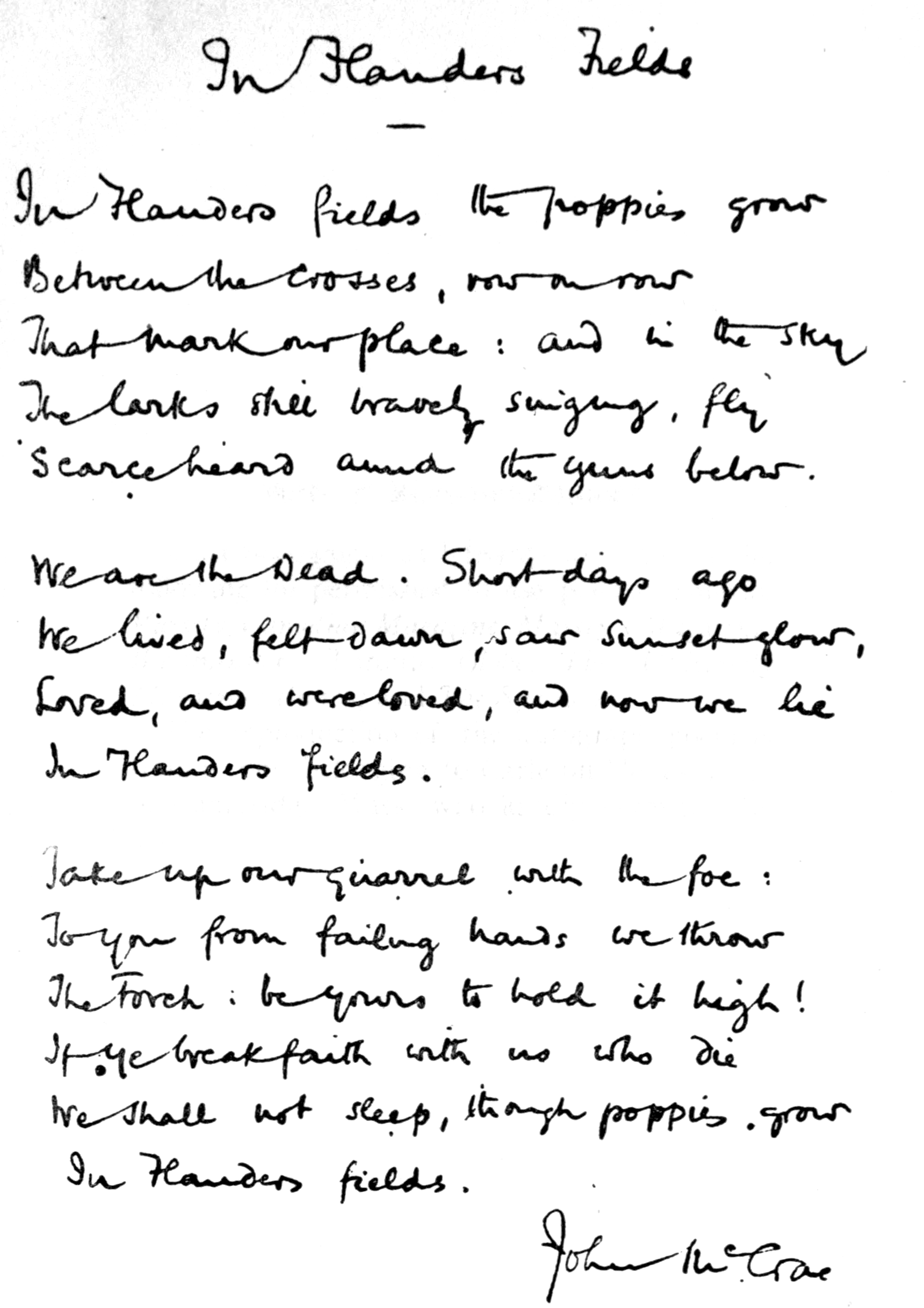
autographed copy of 'In Flanders Fields' by John McCrae


Friday, November 8, 2013

Readsday

I'm just getting over my period, AND I'm apparently getting sick (this fucking better not turn into my yearly winter "sinus infection that festers in my skull for four months while I argue with doctors about antibiotics" gig), but I don't want to get out of the habit, so this shall be short & unsweet.


What did you just finish reading?
A lot of random stuff -- "psychobiographies" of Diane Arbus and Truman Capote; The Lady and Her Monsters, "about" Mary Shelley but really mostly a rehash of biographical gossip with some pop science mixed in; Capote's infamous Answered Prayers; Laura Lippman's Tess Monaghan mysteries. 
I read the Lippman books completely out of order, as usual (something like -- the fourth first, then the third, then the fifth, then the first, and so on), and I'm glad I did, because the first book was not that well-written and had some awful reactionary moments to boot. My favourites in the series are probably In a Strange City (the story of the Poe Toaster! so literary) and The Last Place, and The Sugar House and By a Spider's Thread were reasonably good too. Tess is a fun heroine, strong without being either "feisty" or "kickass," and I like her unrepentant sexuality and independent femininity (long hair, but crew rowing); Lippman is about the equal of Sue Grafton, writing quite readable prose that occasionally snaps into really good sentences. I've read a couple of Lippman's standalone mysteries, which are much more "literary" (sadly) and seem to be trying for a kind of Tana French atmosphere, but she's just not as good a writer. 
I also had a whole post planned out on how disappointing the Hyperbole and a Half hardback was and how blogging isn't really writing and so therefore books made out of blogs are doomed to suck, but I don't have the energy to write it down now. If you buy that book in hardback, as I did, you are a sucker, but apparently a sucker the publishing industry is counting on to keep afloat. I have mixed feelings about this.
(Do I think Amazon running the publishing industry is a terrible idea? Yes. Do I think the "traditional" hardbacks-in-the-warehouse Big Six publishing industry is handling the transition to the modern era terribly and ripping off writers/readers in the process? Yes. Am I constantly dismayed at the horribly shitty quality of proofreading, design and simple font choices in ebooks? Yes. Am I buying nearly all new books as ebooks now because I just don't have the room, let alone the money, for new books in hardback? Yes....)

What are you reading now?
No idea. I need something to hit that sweet spot between "having difficulty paying attention" and "entertain me while I'm feeling ill," which is usually a Pratchett reread, but there are only so many Pratchetts even I can reread and I don't want to wear them out. Mysteries often hit that spot, but I don't want to reread A.J. Orde/B.J. Oliphant/Sheri Tepper right now either....I KNOW, I looked at the shelves (another big problem with ereaders: where are the shelves? You can only see 10-12 books at a time) and apparently I still have a chunk of unread Wilkie Collins, who, as I've discovered before, is perfect sickbed reading. Plus, Sarah Waters' Affinity is right on top of that pile too. Much better.

What do you expect to read next?
Aww, it's Bram Stoker's birthday tomorrow....maybe I'll reread Dracula, I haven't done that in a bit. I'm avoiding the NBC series (mostly because I use the TV we have for streaming Netflix and that's it), but I might rewatch the Coppola film too.

That to-read pile (some of it already read):


Thursday, November 7, 2013

Washing the eyes / of the men who have died

As I mourned by the sea, two images came to mind, watermarking the paper-colored sky. The first was the face of his wife, Laurie. She was his mirror; in her eyes you can see his kindness, sincerity, and empathy. The second was the “great big clipper ship” that he longed to board, from the lyrics of his masterpiece, “Heroin.” I envisioned it waiting for him beneath the constellation formed by the souls of the poets he so wished to join. Before I slept, I searched for the significance of the date—October 27th—and found it to be the birthday of both Dylan Thomas and Sylvia Plath. Lou had chosen the perfect day to set sail—the day of poets, on Sunday morning, the world behind him.

- Patti Smith on Lou Reed's death